The Medieval Church: Preservation, Power & Reform
Rev. Dr. Mathew Philip
Abstract:
The medieval period is the longest and most complex chapter in the history of Christianity. From the fall of the Western Roman Empire in the fifth century to the dawn of the Protestant Reformation in the sixteenth, the medieval Church was a principal religious, cultural, educational, and political institution in Europe. Through centuries of social instability, Christian communities preserved Scripture, theological learning, worship, education, and charitable ministry. Monasteries became centers of prayer, scholarship, and the preservation of manuscripts. Missionaries spread Christianity to new areas. At the same time, the increasing wealth and political power of church institutions caused serious problems such as abuse of authority, corruption, and conflicts between spiritual ministry and temporal power. But the demand for renewal was always coming from within medieval Christianity itself. This article looks at the medieval Church in three interrelated themes: preservation, power, and reform. The article also considers what this period can tell us about the Church today.
Introduction:
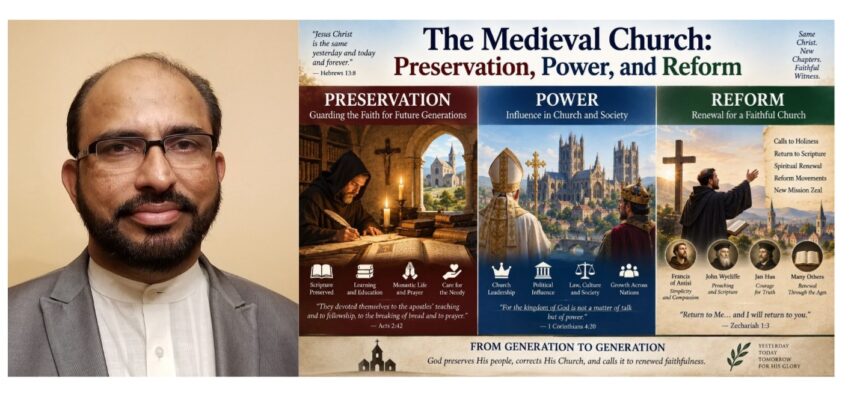
The medieval Church cannot be characterized as an age of uninterrupted spiritual darkness nor as one of ideal Christian civilization. Its history includes great testimonies of faith and serious institutional shortcomings. It produced missionaries, theologians, reformers, charitable institutions, monasteries, universities, and extraordinary works of Christian devotion. But it also had its share of political intrigue, abuses of ecclesiastical power, violence, moral corruption, and practices that eventually provoked widespread calls for reform. The medieval period evolved from a time when Christianity had transitioned from a persecuted minority in the Roman Empire to an increasing association with imperial and political power. In times of social discontinuity, church institutions frequently provided continuity after the weakening and disintegration of the Western Roman Empire. Thus the Church became more than a community of worship. It became an important social institution, concerned with education, law, charity, culture, diplomacy, and politics. Three themes help us understand this complex period: Preservation—the Church’s how we have preserved and transmitted; Power—how the institutional influence shaped and sometimes corrupted its mission; and Reform—the recurring movements that call the Church back to spiritual Faithfulness.
Preserving the Christian Faith:
The medieval Church’s greatest achievement was the preservation and passing on of the Christian faith from generation to generation. With the collapse of Roman political structures in Western Europe, monasteries became important centers of learning. Monks copied by hand biblical manuscripts, works of theology, sermons, and works of classical antiquity. Much ancient literature would have perished without such work. Monastic worship continued to be centered on Scripture. The day’s rhythm was shaped by prayer and Scripture, with the Psalms prayed regularly and passages of Scripture read publicly. The preservation of Christian literature is a reminder that the Church has always been responsible for receiving the faith entrusted to her and handing it on to the next generation. This principle is expressed in Paul’s instruction to Timothy: “And the things that you have heard from me among many witnesses, commit these to faithful men who will be able to teach others also” (2 Timothy 2:2). Every generation of Christians is both a recipient and a steward of the gospel.
Monasticism: Prayer, Learning, and Work:
Monasticism became a defining feature of medieval Christianity. Men and women joined religious communities to live lives of prayer, simplicity, discipline, work, and devotion to God. In the sixth century the Rule of Benedict was created, which had a profound impact on Western monasticism, with a balanced focus on prayer, work, obedience, community and stability. One of the things that monasteries often became centers of was hospitality, education, agriculture, care of travelers, and help to the poor. Some developed libraries and schools which played an important part in intellectual life. Monasticism was not without its flaws, such as too much retreat from normal society or institutional wealth that was contrary to the ideals of simplicity. But at its best, the monastic tradition was a reminder to the wider Church of the importance of prayer, spiritual discipline, community and undivided devotion to God.
Missionary Expansion:
The medieval centuries were also centuries of missionary activity. As Christianity began to take root in lands that had been outside the Roman Christian world, missionaries traveled among the peoples of Europe and beyond. They learned languages, built churches, founded monasteries, educated communities, and translated Christian teaching into new cultural contexts. Major missionary movements were associated with figures like Patrick in Ireland, Boniface among Germanic peoples, and Cyril and Methodius among Slavic populations. This expansion indicates that the Great Commission did not end with the apostolic period. “Go therefore and make disciples of all the nations,” commanded Jesus. (Matt. 28:19) Even at times when institutional Christianity was struggling with compromise, missionary believers continued to carry the Christian message into new areas.
The Rise of Ecclesiastical Power:
As medieval Christianity grew in power, church leaders gained considerable social and political power. Sometimes bishops had civic responsibilities. Popes became powerful in European political affairs. Church institutions acquired land and wealth, and the relations between rulers and church leaders grew more complex. At times this influence allowed the Church to protect vulnerable populations, promote education, mediate conflicts, and restrain political violence. Political power, too, brought serious spiritual dangers. Jesus had cautioned his disciples against imitating worldly patterns of authority: “Whoever wants to become great among you must be your servant” (Matthew 20:26). As ecclesiastical leadership became associated with wealth, prestige, coercion or political ambition, the servant model of Christ could be obscured. The medieval experience shows a persistent danger for Christianity: the Church can exercise influence on behalf of others, but once it begins to seek power for its own sake, its spiritual witness is endangered.
Church and State:
One of the great problems of medieval history was the relation between church and political power. Kings and emperors sometimes attempted to control church appointments, and church leaders asserted authority over matters that affected rulers. Disputes arose concerning who possessed the right to appoint bishops and how spiritual and temporal authority should relate. These conflicts illustrate the difficulty of combining spiritual leadership with political power. The New Testament recognizes legitimate civil authority (Romans 13:1-7), but Jesus distinguished between obligations to earthly authorities and ultimate allegiance to God: “Render therefore to Caesar the things that are Caesar’s, and to God the things that are God’s” (Matthew 22:21). The Church is most loyal to society when its identity and mission are grounded in Christ rather than in political privilege.
Education and the Emergence of Universities:
The medieval Church contributed much to education. Cathedral schools and monastic schools later helped to create the European universities. Cities like Paris, Oxford, and Bologna had institutions that became important centers of intellectual inquiry. While theology was often considered the most prestigious study, philosophy, law, medicine, language, and other disciplines thrived. Important theologians wanted to relate Christian revelation to philosophical reasoning. Thomas Aquinas, for instance, developed a comprehensive theological synthesis that had a profound impact on the development of Christian thought. This intellectual tradition reminds the Church that faith need not fear serious study. Jesus instructed His followers to love God with all their heart, soul, and mind (Matthew 22:37).
Problems and Abuses:
Medieval Christianity was not altogether without its successes, but it had its great problems. Sometimes wealth brought corruption with it. Church offices could become associated with political power or financial interests. Some of the clergy did not display the moral character expected of Christian leaders. Practices surrounding indulgences later became particularly controversial, especially when associated with financial transactions or misunderstood as offering spiritual benefits apart from genuine repentance. For most Christians the Bible was often less than fully accessible in their own tongue, and religious practices could become divorced from biblical knowledge. The contrast between the simplicity of Jesus and the riches of some of the ecclesiastical institutions became increasingly difficult to ignore. These failures remind us of a truth that has never changed: Christian institutions are always in need of spiritual examination and renewal. The Church must always listen to the voice of Christ: “Remember therefore from where you have fallen; repent and do the first works” (Revelation 2:5).
Voices Calling for Reform:
The sixteenth century did not suddenly see the beginning of reform. During the Middle Ages, Christians often called the Church to greater faithfulness to the Bible and spiritual renewal. Monastic reform movements aimed at restoring prayer, simplicity, discipline, and independence from political interference. Francis of Assisi stressed humility, poverty, compassion, and imitation of Christ. Other movements stressed preaching, education, pastoral ministry, and moral renewal. Later figures such as John Wycliffe in England and Jan Hus in Bohemia raised serious questions about ecclesiastical authority, corruption, preaching, and access to Scripture. Not all reformers agreed with one another, and their theological positions varied considerably. But the fact that they existed demonstrates that the desire for renewal was present in medieval Christianity long before the Protestant Reformation.
The Word of God and the Constant Need for Reformation:
The history of the medieval Church tells us why every Christian institution must always be accountable to Scripture. Traditions can preserve wisdom, but they need to be continually examined in the light of God’s Word. Leadership can provide stability, but it has to be servant leadership. Institutions can do great good but must never become an end in themselves. The principle of Acts 17:11 remains important: the Bereans searched the Scriptures to see if what they were being taught was true. The Church is at her healthiest when Scripture is continually calling her back to Christ. Real reform is more than a reshuffling of organizations. It is characterized by repentance, renewed faith, recovery of biblical truth, moral transformation, and renewed dependence on the Holy Spirit.
Lessons for the modern church:
The medieval period has many lessons to teach us. First, it’s about preservation. It is the duty of every generation to preserve and pass on biblical truth. Second, spiritual disciplines are important. Prayer, scripture, worship, simplicity, and disciplined Christian community still matter. Third, education is important. The Church needs to develop thoughtful believers who can bridge faith and culture. Fourth, power must be handled with care. Political power, wealth, institutional success, and public recognition can be temptations of the spirit. Fifth, the Church needs reform always. No denomination, no movement, no institution, no generation is free from the need of repentance and renewal. Finally, Christ must remain at the center. The Church belongs to Him and exists for His glory and mission.
Summary:
The medieval Church leaves a complex but precious heritage. It preserved Scripture and Christian learning, developed traditions of prayer and theological reflection, established institutions of education and charity, and carried Christianity into new cultures. At the same time, its accumulation of institutional and political power sometimes resulted in corruption, coercion, and spiritual compromise. Yet the story of medieval Christianity is also a story of repeated renewal. In the Church there were men and women who called Christians back to prayer, simplicity, Scripture, holiness, compassion, and faithful discipleship. Thus, for the Church, the themes of preservation, power, and reform are still alive today. The Church is to preserve the apostolic gospel, not preserve institutions. It must use whatever power and influence it has in the pattern of the servant Jesus. And it must always be open to reformation and renewal by the work of the Holy Spirit and the authority of the Word of God. The medieval experience reminds every generation that the Church’s greatest strength lies not in wealth, political influence, impressive institutions, or cultural dominance. Its real strength lies in fidelity to Jesus Christ. Where Christ is the Head, Scripture is the authority, leadership is servant-hearted, and the Holy Spirit is continually renewing God’s people, the Church will learn from its history as it faithfully pursues its mission. Thus the medieval Church should not be remembered simply for its successes, nor simply for its failures. It should be studied as a powerful reminder that God preserves His people throughout history, calls His Church to repentance, and continually raises voices of renewal that direct His people back to Christ, His Word, and His mission.