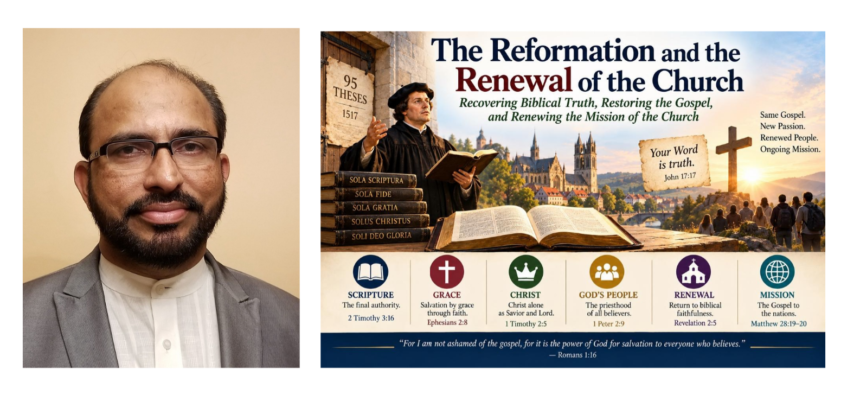
The Reformation and the Renewal of the Church: Recovering Biblical Truth Restoring the Gospel and Renewing the Mission of the Church
Rev. Dr. Mathew Philip
Abstract:
The Protestant Reformation of the 16th century is a watershed event in Christian history. The Reformation was a reaction to centuries of ecclesiastical corruption, doctrinal confusion, and abuse of spiritual authority and aimed to recover the centrality of Scripture, the gospel of salvation by grace through faith, and the biblical identity of the Church. Reformers such as Martin Luther, Huldrych Zwingli, John Calvin, and many others contested the status quo and called Christians to renewed faithfulness to God’s Word. The Reformation created major divisions in Western Christianity but also led to biblical translation, theological education, congregational involvement, and missionary expansion in the centuries to come. The article considers the history, theology, spirituality, and lasting legacy of the Reformation and notes that authentic church renewal involves more than reform of the institutions. It requires constant submission to Scripture, dependence on the Holy Spirit, and renewed commitment to the gospel and mission of Jesus Christ.
Introduction:
The history of the Church has been one of spiritual vitality and seasons of institutional decline, theological confusion, and moral compromise. Still God has raised up voices to call His people back to biblical faithfulness. One of the most important renewal movements in the history of Christianity is the Protestant Reformation of the sixteenth century. It challenged established church structures, practices that obscured the gospel and the authority of human tradition over Scripture. The Reformation was not merely a political revolt or an institutional reorganization. At the heart of its theology lay a fundamental question: How can sinful humanity be reconciled with a holy God? The Reformers responded by going back to the biblical proclamation that salvation is God’s gracious gift, received through faith in Jesus Christ. Apostle Paul says, For by grace you have been saved through faith, and that not of yourselves; it is the gift of God, (Ephesians 2:8). The Reformation reminds the church today that true renewal starts with rediscovering the Word of God, faithful proclamation of the gospel, and the call to repentance and a new way of living.
- Background to the Reformation:
By the late Middle Ages the Western Church had evolved a complex network of religious, political, and institutional structures. There were many Christians who showed real devotion, but in some parts of the church life serious problems had arisen. Widespread discontent was produced by the accumulation of wealth, interference of government in church affairs, poor pastoral education, and abuses in the sale of indulgences. The Renaissance led to a reexamination of ancient sources and biblical manuscripts. The printing press was invented, and religious ideas spread more quickly. Earlier reformers, such as John Wycliffe and Jan Hus, had already questioned certain aspects of church authority and had called for a closer adherence to Scripture. So the way was prepared for the Reformation of the sixteenth century. Martin Luther is traditionally said to have posted his Ninety-Five Theses in Wittenberg on October 31, 1517, calling into question abuses associated with indulgences. What started as a theological dispute became a movement of great importance that transformed Christianity in Europe and profoundly affected the Church around the world. - The Authority of Scripture (Sola Scriptura):
One of the key ideas of the Protestant Reformation was Sola Scriptura, or Scripture alone, as the highest and ultimate authority for Christian belief and behavior. The Reformers weren’t necessarily against all church traditions. Rather, they insisted that traditions and ecclesiastical teachings had to be tested by the written Word of God. Paul writes, “All scripture is given by inspiration of God and is profitable for doctrine, for reproof, for correction, for instruction in righteousness” (2 Timothy 3:16). This belief was the reason why the Bible was translated into languages that ordinary believers could understand. Luther translated the New Testament into German, and other reformers promoted biblical translation and literacy. The Reformation affirmed that the Church is not above Scripture. But instead, the church needs to always be under the authority of God’s Word. It is of the very essence of the Church today. Real renewal cannot be sustained by programs, traditions, personalities, or institutional strategies alone. It must be founded on Scripture. - Salvation by Grace Through Faith:
The doctrine of justification by faith became the heart of reformational theology. Martin Luther’s reading of Romans, particularly Romans 1:17, helped him to realize that sinners are justified before God by faith in Jesus Christ and not their own meritorious works. Paul says to us, “Therefore, since we have been justified through faith, we have peace with God through our Lord Jesus Christ” (Romans 5:1). The Reformers stressed that salvation depends solely on God’s grace and Christ’s saving work. This understanding is summarized in the well-known Reformation formulae: Sola Scriptura: The Bible Alone as the Highest Authority. Sola Fide (Justification by Faith Alone) Sola Gratia: By grace alone salvation. Solus Christus: Christ alone, as the only mediator and savior. Soli Deo Gloria. Glory to God Alone. These principles were intended to recenter the gospel. Salvation is not something we can earn; it is a gift from God. Good works are the fruit of true faith, not the means to earn salvation. - Jesus Christ at the Heart of the Church:
The Reformation stressed the sufficiency of Jesus Christ as Savior and Mediator. Scripture says, “For there is one God and one Mediator between God and men, the Man Christ Jesus” (1 Timothy 2:5). It is because of Christ, it belongs to Christ, and it is called to proclaim Christ. The Reformers resisted practices they believed hid the unique saving work of Jesus. This Christ-centered emphasis is relevant whenever churches become too dependent upon charismatic personalities, institutional prestige, religious ceremonies, or human achievements. The Church must be Christ-centered rather than personality-centered; Gospel-centered rather than institution-centered; and Scripture-centered rather than tradition-controlled. And every true revival movement must eventually turn the attention from man’s glory to Jesus Christ. - The Universal Priesthood:
Another major emphasis of the Reformation was the priesthood of all believers. Peter calls Christians “a royal priesthood, a holy nation, His own special people” (1 Peter 2:9). Through Christ all believers are in fellowship with God and have a part in worship, witness, prayer, and Christian service. This teaching challenged the assumption that meaningful Christian ministry was the sole domain of ordained clergy. The Reformers emphasized the spiritual calling of ordinary believers in their homes, workplaces, congregations, and communities. However, the priesthood of believers does not exclude pastoral leadership. Rather it situates leadership within the framework of the larger ministry of the whole Church. The pastors provide teaching and spiritual oversight to equip believers. All Christians participate in God’s mission. A healthy church is not a passive congregation served by a few religious professionals but an active community of disciples functioning in the responsibilities God has given them. - The Reformation and the Renewal of Worship:
The Reformation also altered the ways Christian worship was performed. Many Protestant reformers stressed preaching, congregational singing, public prayer, and other more active participation by ordinary believers. Scriptural reading and biblical exposition became a central part of worship services. While Martin Luther encouraged congregational hymn singing, Reformed traditions developed forms of worship that stressed the proclamation of God’s Word. Protestant traditions differed in their views on baptism, the Lord’s Supper, and church government. But there was a shared concern that worship must glorify God, communicate biblical truth, and foster authentic faith. The worship of the Church must never degenerate into an impressive religious spectacle. It should lead believers to awe, remorse, gratitude, obedience, and a closer communion with God. - Reform and Division: The Complicated History of the Church:
The Reformation was a time of great renewal, but it also contributed to the divisions in Western Christianity that continue to this day. The Lutheran, Reformed, Anglican, and Anabaptist traditions formed their own theological convictions and church structures. The Roman Catholic Church, too, began significant reforms, especially through the Council of Trent and subsequent movements of spiritual and institutional renewal. It was an era of theological debate, political turmoil, and, sadly, religious violence. These realities are a reminder that even movements seeking biblical truth can be vulnerable to human frailty. We should study the Reformation with thankfulness for its theological gifts and humility in its failures. Christian renewal must never be confused with hostility toward other believers. Faithfulness to truth should always be accompanied by love, humility, and a sincere desire for peace. - The Reformation and Later Evangelical Revival:
The Reformation’s effects reached far beyond the sixteenth century. Its focus on Scripture, personal faith, and the gospel contributed to the development of later Protestant traditions and renewal movements. Puritanism, Pietism, Methodism, evangelical revivals, missionary movements, and finally modern Pentecostalism all emerged in the wider historical world created by the Reformation. But they also had other theological and historical influences. Particularly in the Pentecostal movement, emphasis was placed on the continuing work of the Holy Spirit, spiritual gifts, evangelism, holiness, and missionary empowerment. Biblical renewal from a Pentecostal perspective involves both the authority of the Word and the transforming power of the Holy Spirit. The early Church was apostolic in its foundation and Spirit-filled in its witness. The church today must ever and again recover these biblical characteristics. When the Word is separated from spiritual obedience, it is merely information. And claims of spiritual experience without biblical discernment are invitations to confusion. Real renewal is a matter of biblical truth and Spirit-led living. - The Continuing Need for Reformation:
The need for renewal in the Church did not end in the sixteenth century. Every generation is tempted to institutional pride, spiritual complacency, moral compromise, theological confusion, and neglect of mission. The message to the church at Ephesus still applies “Remember therefore from where you have fallen; repent and do the first works” (Revelation 2:5). Repentance is the start of renewal. It continues by means of prayer, biblical teaching, holiness, accountable leadership, compassionate fellowship, and renewed commitment to evangelism. Church reform must address both doctrine and life. Correct theology without love becomes spiritually barren. Emotional enthusiasm without biblical grounding becomes unstable. Organizational growth without discipleship becomes superficial. The Church needs an ongoing reformation of its beliefs, character, worship, relationships, and mission.
Summary:
The Protestant Reformation is still an epoch-making event in Church history because it provoked Christians to restore biblical authority, to proclaim salvation by grace through faith, and to restore the centrality of Jesus Christ. Its significance is not in the founding of Protestant churches but in its continuing challenge to assess the faith and practice of the Church in the light of the Word of God. The teaching of the Reformation is that the Church must always be reformed by the truth she preaches. But authentic renewal is never merely intellectual or institutional. It’s about changed hearts, holy living, Spirit-led worship, servant leadership, Christian unity, and missionary faithfulness. The Church must hold fast to the apostolic gospel, but it must also be open to the sanctifying and empowering work of the Holy Spirit. As God’s people, as we approach the promised return of Jesus Christ, the call to renewal is urgent. The Church must continue to return to the Scriptures, rediscover the riches of grace, exalt Christ above every human institution, and faithfully fulfill the Great Commission. The Church is renewed not by changing its structures, but when its people return to Christ, submit to His Word, depend upon His Spirit, and recommit themselves to His mission. The Reformation’s lasting message is therefore a call to each generation, back to the Scriptures, back to the gospel, back to Christ, and forward in the power of the Holy Spirit.