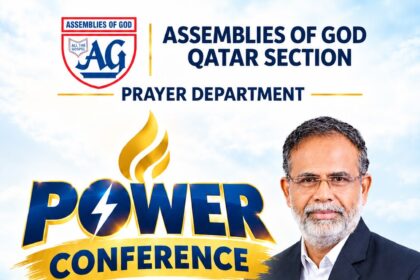
Rev. Dr. Mathew Philip
Introduction:
The apostle Paul’s brief yet profound words in Romans 12:4–5 offer a compelling vision of what a transformed church looks like: “For just as each of us has one body with many members, and these members do not all have the same function, so in Christ we, though many, form one body, and each member belongs to all the others.” In a world marked by fragmentation, competition, and individualism, this passage calls the church to embody a radically different way of living—one shaped by unity, mutual belonging, and Christ-centered dependence. Paul’s imagery of the body provides not only theological insight but also practical guidance for how the church is meant to live and serve today.
1. The Church Is Like a Human Body:
Paul begins with an image familiar to every reader: the human body. A body is a living, organic whole, composed of many different parts, each with a distinct function. Eyes see, hands work, feet walk, and the heart pumps life through the entire system. No part exists in isolation, and no part can claim self-sufficiency.
By using this metaphor, Paul emphasizes that the church is not a mechanical institution or a mere collection of individuals. It is a living organism. Diversity within the church is not a weakness to be managed but a strength designed by God. Different gifts, callings, personalities, and roles are essential for the healthy functioning of the whole. When the church understands itself as a body, it learns to value cooperation over competition and interdependence over independence.
2. The Body Is Christ’s Body
Paul goes further by identifying this body as belonging to Christ. The church is not simply like a body; it is the body of Christ. This truth elevates the church’s identity and mission. Christ is not distant from His people; He is intimately connected to them. Through the church, Christ continues His presence and work in the world.
This means that the church’s life and witness must reflect the character of Christ Himself. When the church serves the poor, welcomes the stranger, speaks truth, and offers grace, it is Christ acting through His body. Conversely, when the church is divided, indifferent, or self-serving, it misrepresents its Head. Recognizing the church as Christ’s body calls believers to a deep sense of reverence, responsibility, and humility in how they live together and engage the world.
3. Members of the Church Are Individually Important
In the body metaphor, Paul affirms the value of every member. No part of the body is unnecessary, and no role is insignificant. This is a vital word for churches where some feel overlooked, undervalued, or dispensable. Spiritual gifts, acts of service, prayer, encouragement, teaching, and hospitality all matter deeply in God’s economy.
A transformed church resists the temptation to elevate only visible or prominent roles. It recognizes that faithfulness in small, unseen acts is just as crucial as leadership on a public platform. Each believer is uniquely gifted and intentionally placed within the body. When members embrace their God-given identity and calling, the church grows in health, maturity, and effectiveness.
4. The Church Is Dependent on Jesus Christ
Although Romans 12:4–5 does not explicitly name Christ as the “head,” Paul’s broader theology makes this dependence unmistakable. The body cannot exist or function apart from Christ. He is the source of life, direction, and unity. Without Him, the church becomes an empty structure, sustained by human effort rather than divine power.
Dependence on Christ is expressed through worship, prayer, obedience to Scripture, and openness to the work of the Holy Spirit. A transformed church continually looks to Jesus for guidance and strength, acknowledging that fruitfulness flows from abiding in Him. This dependence guards the church against pride and self-reliance, keeping it rooted in grace.
5. The Church Is One
Finally, Paul emphasizes the oneness of the church: “so in Christ we, though many, form one body.” Unity does not mean uniformity. Differences remain, but they are held together by a shared life in Christ. The key to unity is valuing differences. Members of the church must be receptive to the Holy Spirit, who truly fosters unity among them. This unity is both a gift and a calling—something God has given and something believers must actively live out.
In a divided world, the church’s unity becomes a powerful witness to the reconciling work of Christ. When believers love one another, bear one another’s burdens, and remain committed to one another despite differences, they demonstrate the reality of the gospel. A transformed church is a community where belonging replaces isolation and shared purpose overcomes division.
Conclusion
Romans 12:4–5 presents a vision of the church that is deeply countercultural and profoundly hopeful. The church is a living body, Christ’s own body, made up of many valued members, wholly dependent on Jesus, and united as one in the Holy Spirit. When this vision shapes the church’s life, it becomes a visible sign of God’s transforming grace—a community that reflects Christ to the world and invites others into the life-giving unity found in Him