Rev. Dr. Mathew Philip
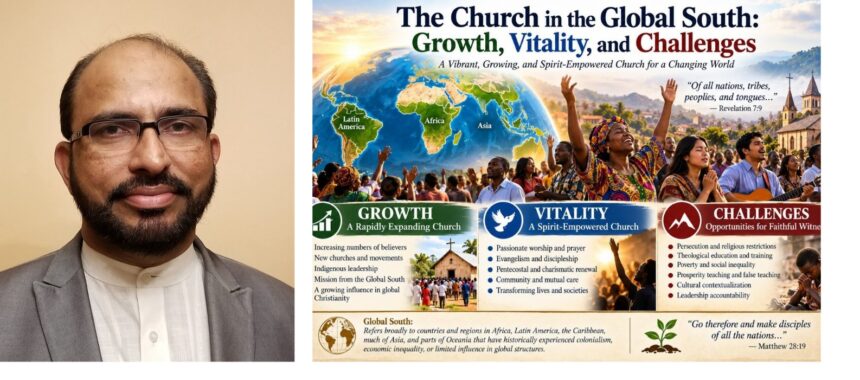
Continuing the “All About Church” series, this article explores the remarkable growth of Christianity in the Global South, highlighting its spiritual vitality, missionary influence, and the challenges facing emerging Christian communities. The “Global South” generally refers to countries and regions in Africa, Latin America, the Caribbean, much of Asia, and parts of Oceania that have historically experienced colonialism, economic inequality, or a lack of power in global political and economic structures. It is mostly a historical socio-economic and geopolitical designation and not a strictly geographical one. When considering global Christianity, the term refers to regions where Christian communities have grown rapidly and have gained in influence in recent decades, particularly in sub-Saharan Africa, Asia, and Latin America. These areas have become major centers of Christian worship, theological reflection, evangelism, Pentecostal and charismatic renewal, and missionary activity. The expansion of Christianity in the Global South is among the most important changes in the demographic and spiritual profile of world Christianity. It means that the Church is becoming more multicultural, multinational, and globally networked.
Abstract:
One of the most significant developments in modern Christian history is the remarkable growth of Christianity in the Global South, especially in Africa, Asia and Latin America. Christianity has grown to be a more diverse and widely dispersed religion, once largely tied to European and North American institutions. Indigenous churches, Pentecostal and charismatic movements, evangelical communities, and missionary initiatives have altered the demographic and spiritual landscape of world Christianity. This development is a testimony to the continuing vitality of the Christian gospel across cultural, language, and geographic lines. But growth has also brought challenges of theological education, leadership formation, religious persecution, economic inequality, prosperity teaching, and cultural contextualization. This article reflects on the growth, spiritual vitality, and challenges of Christianity in the Global South, emphasizing the value of biblical faithfulness, Spirit-empowered ministry, indigenous leadership, and responsible missionary engagement.
Introduction:
The geography of Christianity has changed dramatically. For several centuries European and North American institutions had a considerable influence on global Christian theology, missions, education, and ecclesiastical organization. But today a large proportion of the world’s Christians live in Africa, Asia, Latin America, and other parts of what is often called the Global South. But it’s more than just a demographic shift. It marks a major change in the cultural expressions, spiritual practices, missionary leadership, and theological perspectives of global Christianity. Revelation 7:9 offers a glimpse of a redeemed crowd “Of all nations, tribes, peoples, and tongues, standing before the throne and before the Lamb.” The growth of Christianity in the Global South is a reminder to the Church that the gospel was never meant to be limited to one civilization or geographical region. Three themes characterize this transformation: extraordinary growth, a rich spiritual life, and great challenges that demand biblical wisdom and responsible leadership.
- Historical Emergence of Christianity in the Global South
Christianity has deep roots in areas that today are associated with the Global South. Well before the rise of modern European missionaries, the early Church developed important centers in North Africa, Egypt, Ethiopia, Syria, and parts of Asia. Missionary movements, Bible translation, educational institutions, medical ministries, indigenous evangelists, and local revival movements accelerated the modern growth of Christianity in these regions. During the nineteenth and twentieth centuries, African, Asian, and Latin American Christians increasingly established their own congregations, leadership structures, theological institutions, and missionary organizations. This development challenged the idea that Christianity was mainly a Western religion. The Christian faith is universal because its message is the salvation of all mankind through Jesus Christ. - Christianity’s Amazing Growth in Africa:
One of the greatest expansions of Christianity in modern times has been in sub-Saharan Africa. Throughout the continent, churches representing Catholic, Protestant, evangelical, Pentecostal, and African-initiated traditions have developed. African Christianity is often marked by lively congregational worship, prayer, evangelism, community participation, and a strong emphasis on the supernatural dimensions of the Christian faith. African-initiated churches have played an important role in articulating Christianity in local cultural forms while seeking to maintain biblical identity. However, African Christianity is not uniform. The continent is extraordinarily diverse theologically, culturally, and denominationally. Its growth demonstrates that Christianity can flourish outside its old centers of institutional power. - Christianity in Asia: Faith in Diversity
Asia provides a different, yet equally important Christian context. Christianity has grown considerably in countries like South Korea, the Philippines, and parts of China. Believers in India, Indonesia, and other Asian societies live in very diverse religious environments. Asian Christians often have to navigate religious identity, minority status, cultural practices, interreligious relations, and political repression. In some areas, churches are persecuted or restricted in their religious freedom. Elsewhere, Christian communities run schools, hospitals, universities, and charitable organizations. Asian Christianity shows the importance of faithful witness in religiously pluralistic societies. The apostle Peter instructs believers to “always be ready to give a defense to everyone who asks you a reason for the hope that is in you, with meekness and fear” (1 Peter 3:15). Christian witness must be a mixture of theological conviction and humility, respect, and compassion. - Latin America and the Rise of Evangelical Christianity:
Roman Catholicism has historically been a strong influence in Latin America. However, during the twentieth century, the evangelical and Pentecostal churches increased considerably throughout the region. These movements emphasized personal conversion, Bible reading, congregational participation, healing prayer, evangelism, and community fellowship. Pentecostal Christianity became especially strong among many urban and economically deprived communities. Local churches were often where ordinary people found a spiritual home, help from their neighbors, moral guidance, and the chance to exercise leadership. The Latin American experience shows how Christianity can respond to social transformation, developing new expressions of worship and community life. - Pentecostalism and Spiritual Vitality:
The Pentecostal and charismatic movements have played an important role in the expansion of Christianity in the Global South. Such movements emphasize the present ministry of the Holy Spirit, prayer, spiritual gifts, healing, evangelism, and the hope of the return of Christ. One foundational biblical vision is Acts 1:8: “But you shall receive power when the Holy Spirit has come upon you; and you shall be witnesses to Me.” Pentecostal spirituality encourages the active participation of ordinary believers and does not limit ministry to formally trained clergy. Congregational vitality often comes from prayer meetings, evangelistic meetings, testimonies, and small group fellowship. But spiritual experiences need to be tested and judged by the Scripture. The Holy Spirit who empowers the Church leads people to truth, holiness, humility, and Christlike character. A Spirit-filled Church must also be a Scripture-based, Christ-centered, need-oriented, and mission-minded church. - Indigenous Leadership and the Local Church Growth:
The emergence of indigenous leadership is one of the major developments in Global South Christianity. Many missionary institutions traditionally relied on outside administrative control and foreign financial aid. Today, churches in Africa, Asia, and Latin America are more and more training their own pastors, theologians, missionaries, educational institutions, and ministry networks. The principles of autonomous, self-supporting, and self-propagating churches still matter. Indigenous leadership means that churches can share the gospel in ways that are meaningful to them in their own languages and cultures. Also, it calls the worldwide Church to the missionary responsibility of all believers, not only Christians from economically advantaged countries. - Theological Training and Biblical Discipleship:
The church is growing very fast, and there is an urgent need for theological education and spiritual formation. In some parts of the world congregations grow more rapidly than trained pastoral leadership can be developed. This leaves one open to doctrinal confusion, manipulative leadership, superficial discipleship, and misuse of Scripture. “The things which you heard from me among many witnesses, commit these to faithful men who will be able to teach others also” (2 Timothy 2:2). Thus, biblical teaching, pastoral training, theological education, and mentoring are essential for long-term development of the church. Healthy churches require more than numerical growth. They need spiritually mature believers who know the Scripture and model Christlike character. - Economic Challenges and the Prosperity Gospel:
Economic inequality poses major challenges to many Christian communities in the Global South. Churches often help communities struggling with poverty, unemployment, poor health care, and limited access to education. In such settings, teachings promising guaranteed riches or physical cures in return for money can prove especially attractive. But the prosperity teaching becomes dangerous when material success is presented as the necessary evidence of God’s blessing or when suffering is always the result of lack of faith. Jesus warned: “One’s life does not consist in the abundance of the things he possesses” (Luke 12:15). The biblical gospel calls believers to faith, contentment, generosity, stewardship, and perseverance. The Church must preach the love of God for human needs, without making salvation a question of material prosperity. - Persecution, Religious Liberty, and Faithful Witness:
In some parts of the Global South, Christian communities face considerable hostility. Some are subject to legal restrictions, social discrimination, violence, or pressure from religious and political authorities. These are challenges that call for courage, wisdom, prayer, and solidarity from the Christian community across the world. Jesus said, “In the world you will have tribulation, but be of good cheer, I have overcome the world” (John 16:33). The suffering Church reminds us that Christian discipleship can be expensive. At the global level Christian solidarity should be expressed in prayer, in humanitarian aid, in responsible advocacy, and in practical support for vulnerable communities. - Cultural Contextualization and Biblical Faithfulness:
As Christianity crosses cultures, churches must learn to separate biblical truth from cultural expressions. Worship styles, music, language, dress, and community practices can be very different. Such diversity can be a blessing for the universal Church. But culture practices must be evaluated in light of Scripture. Healthy contextualization is the articulation of the unchanging gospel in culturally meaningful local expressions, without compromise of core Christian convictions. The Church should avoid both cultural domination and uncritical accommodation. More than cultural competence, we need cultural humility. Church’s ultimate identity is neither ethnic nor national but Jesus Christ. - The Global South as a Sending Community of Missionaries:
A notable aspect of contemporary Christianity is the increasing missionary role of churches in the Global South. Increasingly, churches in Africa, Asia and Latin America are sending missionaries to other regions, including Europe and North America. The mission is not sufficiently described as movement from the West to the rest of the world. It is more and more everyplace to everyplace mission. This change is an expression of the New Testament understanding of the Church as a community of mission, empowered by the Holy Spirit. Every congregation, regardless of economic resources or geographic location, can be a partner in God’s global mission.
Summary:
The amazing rise of Christianity in the Global South is one of the most amazing events in modern Church history. Churches in Africa, Asia, and Latin America have encouraged the growth of world Christianity through evangelism, prayer, local leadership, theological reflection, missionary activity, and vigorous worship. But with growth comes responsibility. The Church has to address theological confusion, lack of pastoral training, economic exploitation, religious persecution, cultural tensions, and accountability of leadership. Numerical growth must be coupled with spiritual maturity, biblical faithfulness, and Christlike character. The future of world Christianity will not be decided merely by the number of congregations planted but by their commitment to Scripture, discipleship, holiness, compassionate service, and the Great Commission. From a biblical and Pentecostal point of view, the Church should be apostolic in teaching, Pentecostal in spiritual power, Christ-centered in worship, holy in character, and missionary in purpose. The growth of Christianity in the Global South reminds the global church that God’s redemptive mission is beyond every geographical, cultural, and political boundary. The Church belongs to no single nation or civilization. It belongs to Jesus Christ. Believers from all continents are involved in God’s mission, and the vision of Revelation 7:9 is becoming more and more visible—a redeemed people from every nation, tribe, people and language standing before the throne of God. Until that glorious day, the Church must continue to preach the gospel, make disciples, develop faithful leaders, and serve communities with compassion. The Global South is not only a new center of Christian growth; it is also an increasingly influential partner in the worldwide mission of God, witnessing to Jesus Christ until He comes again.