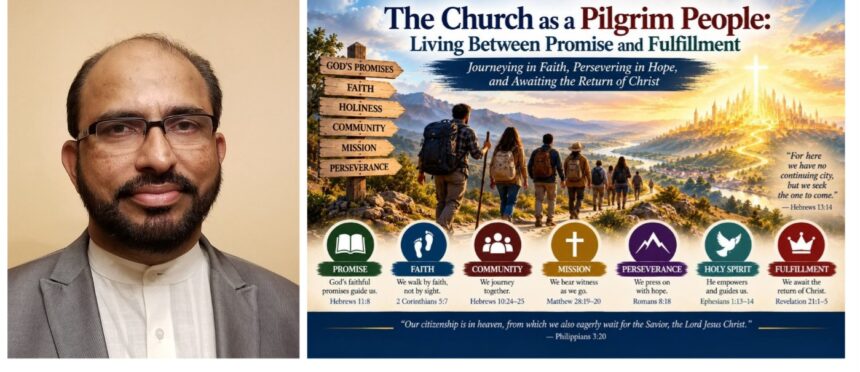
Rev. Dr. Mathew Philip
Abstract:
Continuing the “All About Church” series, this article explores the Church’s identity as a pilgrim community journeying through history toward the fulfillment of God’s promises in Jesus Christ. The New Testament presents the Church as a pilgrim people, journeying through the present age to the final realization of God’s redemptive promises. Believers are already saved in Jesus Christ, and they experience the presence of the Holy Spirit. However, they live in a world of suffering, sin, uncertainty, and death. In this way the Church lives in the theological tension of the “already” and the “not yet”—already redeemed, but not yet glorified; already citizens of heaven, but still on earth; already tasting God’s Kingdom but waiting for its consummation. In this article I examine the biblical roots of the pilgrim identity of the Church, with special attention to faith, holiness, perseverance, community, mission, and eschatological hope. Seeing the Church as a pilgrim people calls believers to live faithfully in the present, with an eye on the glorious return of Jesus Christ.
Introduction:
The Christian Church is not merely an institution that exists to operate within human history. It is a redeemed community on a journey through history to the fulfillment of God’s eternal purposes. The Bible frequently refers to believers as pilgrims, strangers, and sojourners. These statements remind Christians of their ultimate identity and destiny beyond this world. Apostle Peter says, “Dear friends, remember that you are strangers and aliens in this world, and I beg you to keep away from the evil desires that are fighting against your soul” (1 Peter 2:11 TLB). The Church is Christ’s, and partakes in His mission in the world, but it does not have its ultimate home in this present order of things. Christians exist between two decisive events. The first is the coming of Jesus Christ, by which redemption was accomplished. The second is his coming again, when God’s redemptive purposes will reach their final fulfillment. Hence, the Church is a pilgrim community, called to walk by faith, to suffer, to show forth holiness, and to witness to the coming Kingdom.
The Biblical Meaning of Pilgrimage:
Often the Bible uses the theme of pilgrimage, depicting the life of faith as a journey toward God’s promised destination. The most obvious examples of Scripture are from Abraham. God told him to leave his native country and go to a land that he had not yet seen. Hebrews 11:8 tells us, “By faith Abraham, when he was called, obeyed to go out to the place which he was to receive for an inheritance.” Abraham’s journey was one of obedience, uncertainty, dependence, and hope. He lived as an alien in the promised land, looking beyond his immediate circumstances to God’s ultimate promise. Hebrews 11:10 tells us that Abraham sought “the city which has foundations, whose builder and maker is God.” The Church, too, shares this pilgrim identity. Like Abraham, believers trust in God’s promises even when they are not seen. Christian pilgrimage is not merely a journey from one geographical point to another but a spiritual journey from faith to fulfillment.
The Church in the Space Between the Already and Not-Yet:
One of the most important theological dimensions of the pilgrim identity of the Church is the tension between what God has already done and what remains to be done. By the death and resurrection of Christ, believers have already obtained forgiveness, reconciliation, justification, and new life. “Therefore, since we have been justified by faith, we have peace with God through our Lord Jesus Christ.” (Romans 5:1) But Christians still experience weakness, temptation, suffering, aging, and death. Paul speaks of believers waiting for “the redemption of our body” (Romans 8:23). So the Church is redeemed already, but not yet glorified. It already experiences the blessings of God’s Kingdom but looks forward to the final defeat of evil and the restoration of creation. This theological tension guards against two opposite errors: expecting full perfection in the present world and losing hope because suffering continues. The pilgrim Church lives by faith because God’s promises have begun to be fulfilled in Christ and will surely be fulfilled.
Citizens of Heaven Residing on Earth:
The apostle Paul reminds believers, “For our citizenship is in heaven, from which we also eagerly wait for the Savior, the Lord Jesus Christ” (Philippians 3:20). Being a citizen of heaven doesn’t mean Christians should retreat from earthly responsibilities. Rather, it means that their ultimate allegiance is to Jesus Christ. Still, believers are responsible citizens, neighbors, parents, workers, and members of the society. They are called to seek justice, to show compassion, to act with integrity, and to make a positive contribution to their communities. But their primary identity in Christ must never be replaced by earthly nationality, political identity, economic status, and cultural traditions. The Church is a pilgrim people because it belongs to a kingdom that transcends all earthly limits. It has no final loyalty to any nation or institution but to the King of kings.
Faith as the Foundation of the Pilgrimage:
Pilgrimage requires faith, because the destination is a promise yet unseen. The writer of Hebrews describes faith in Hebrews 11:1 as “the substance of things hoped for, the evidence of things not seen.” The Christian walk involves trusting God through things that may seem uncertain or contradictory. Disciples don’t always know the why of suffering, the why of unanswered prayers, or the why of delayed promises from God. But faith is based on the character of God, not the predictability of circumstances. Paul writes, “We walk by faith, not by sight” (2 Corinthians 5:7). The pilgrim church endures because it believes in the One who called her. Faith doesn’t get rid of questions or problems. It encourages believers to be obedient while waiting for God to fulfill.
Holiness on the Journey:
The pilgrim identity of the Church has significant ethical implications. Christians are called to a different life from the world around them because they belong to Christ. Peter calls believers to honorable living among the nations (1 Peter 2:11–12). A Christian’s holiness is about resisting sinful desires, living with integrity, showing love, and demonstrating the character of Jesus Christ. The pilgrim Church must not become so comfortable with the values of the world that it forgets its heavenly calling. The drive for worldly power, materialism, pride, greed, immorality, and bitterness can divert believers from their eternal destination. Jesus cautioned, “For where your treasure is, there your heart will be also” (Matthew 6:21). Holiness is not separation from people, but separation from sin. The Church is called to be in the world and to show the transforming power of the gospel.
The Suffering and the Pilgrim Church:
There are challenges in the Christian walk. Jesus tells His disciples: “In the world you will have tribulation, but be of good cheer, I have overcome the world” (John 16:33). Christians have endured persecution, displacement, poverty, sickness, grief, and uncertainty throughout history. The pilgrim perspective helps Christians understand that suffering now does not dictate their final destination. Paul writes, “For I consider that the sufferings of this present time are not worth comparing with the glory which is to be revealed to us.” (Romans 8:18). This promise does not reduce human suffering. Instead, it locates suffering in the larger story of God’s redemption. In prayer, in pastoral care, in encouragement, and in practical compassion the Church stands in solidarity with the suffering. Pilgrim hope does not ignore present suffering; it affirms that suffering will not have the last word.
The Church as a Pilgrim People:
A Christian pilgrimage is not just a solitary experience. The Church travels together as the body of Christ. The first believers gave themselves to the teaching, fellowship, the breaking of bread, and prayer (Acts 2:42). It was these practices that kept the Christian community going in the face of opposition and uncertainty. In like manner, the Church today is called to build up believers through worship, discipleship, fellowship, pastoral care, and mutual encouragement. Hebrews 10:24–25 urges Christians not to neglect meeting together, but to encourage one another as they anticipate the coming Day. No believer is meant to walk the Christian journey alone. The Church is a spiritual family where the strong help the weak, the hopeful encourages the discouraged, and the community walks together toward God’s promised future.
The Holy Spirit: The Companion and the Assurance:
The Holy Spirit plays a central role in the pilgrim journey of the Church. Jesus promised the Spirit would be with His people and guide them into truth. Paul calls the Holy Spirit the guaranty of the believer’s inheritance (Ephesians 1:13–14). The Spirit reassures Christians that their future is God’s future. He strengthens the weak. He grows spiritual fruit. He empowers witnesses. He maintains hope. The Church, therefore, does not travel to its goal by human strength alone. It is led and empowered by the Holy Spirit. For Pentecostals, the presence of the Spirit is evidence of both the present activity of God and the hope of the fullness of His Kingdom to come.
Pilgrimage and the Mission of the Church:
The Church’s heavenly destiny does not eliminate its earthly mission. Rather, the certainty of Christ’s return gives urgency to evangelism and discipleship. Jesus told His followers to “go and make disciples of all nations” (Matthew 28:19–20). The pilgrim Church, then, is a community of witness on the journey through the world. It announces salvation through Jesus Christ, is compassionate, serves those in need, and invites others to the journey of faith. Its mission is to bear witness to the Kingdom of God, not to establish on a permanent basis an earthly kingdom by human power. Now the Church must be faithful because she knows that history is moving toward God’s promised fulfillment.
The Heavenly City: The Completion of the Journey:
The pilgrim Church’s final destination is described in Hebrews 13:14: “For here we have no continuing city, but we seek the one to come.” The book of Revelation portrays the ultimate realization of God’s promises in the new heaven and new earth. “Behold, the tabernacle of God is with men, and He will dwell with them” (Revelation 21:3). John says, “In the new creation God’s people will know his presence without the barriers of sin, suffering, and death.” Revelation 21:4 assures us that God will wipe away all tears, and there will be no more death, sorrow, crying, or pain. The Christian pilgrimage, then, is toward restoration rather than destruction, fulfillment rather than disappointment, and eternal fellowship rather than separation. The pilgrim Church looks forward to the day when faith will be seen and hope fulfilled.
Summary:
The Church as a pilgrim people is a powerful biblical image that captures the identity, calling, and destiny of the Christian community. Christians live between the time of Christ’s first coming and His promised return, between redemption accomplished and redemption fully revealed, and between present spiritual blessings and future glory. Like Abraham, the Church journeys by faith toward the goal promised by God. God’s people are like Israel in the wilderness. They are dependent on God’s guidance and provision. Like the early Christians, the Church is committed to worship, fellowship, holiness, and missionary witness. It is a way of pain, doubt, and spiritual conflict, but it is empowered by the promises of God and the enabling power of the Holy Spirit. The Church should not become too attached to earthly institutions, possessions, political influence, or temporary achievements. Its final identity is Jesus Christ, and its ultimate destination is the renewed creation in which God will dwell forever with his redeemed people. The Church is not a community that has arrived but a community that is on the way to the fulfillment of the promises of God. Until Christ returns, believers are called to walk faithfully, love deeply, serve compassionately, persevere courageously, and joyfully proclaim the gospel. The pilgrim Church walks on confidently because the risen Lord guarantees her the destination. We live in holiness, serve in love, endure in hope, and wait for the glorious appearing of Jesus Christ. The journey goes on, but the promise is sure: the One who called His people will faithfully bring them home.