Rev. Dr. Mathew Philip
Abstract:
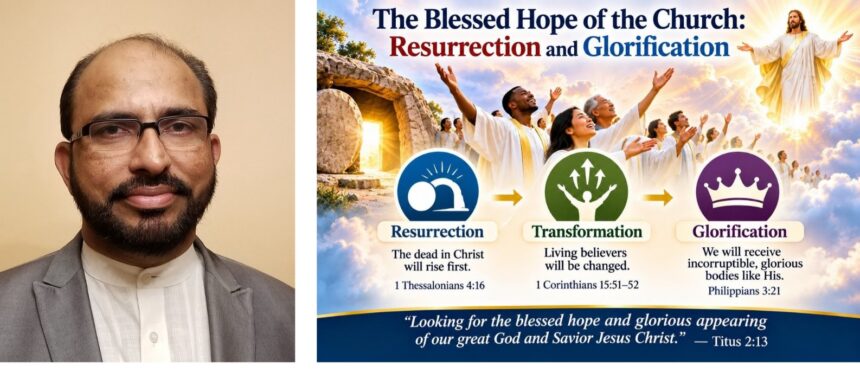
The Blessed Hope of the Church is based upon the return of Jesus Christ, the resurrection of believers, and their final glorification in His presence. Christian eschatology says that death is not the last word, for Jesus Christ has defeated sin and death by his resurrection. The apostle Paul speaks of the transformation of believers from mortality to immortality and from corruptibility to incorruptibility. The Church therefore lives in expectation of a glorious future when the dead in Christ will be raised, living believers will be transformed, and God’s redeemed people will be reunited with their Savior forever. This article examines the biblical basis of the Blessed Hope, the resurrection of the body, the glorification of the believers, and the relationship between the return of Christ and the eternal destiny of the Church. It also examines the practical implications of resurrection hope for Christian holiness, perseverance, pastoral ministry, and faithful witness.
Introduction:
The Christian Church, from its inception, has existed in the hope of a glorious future beyond suffering, death, and the limits of this earthly state. Christian hope is not like human optimism, which is dependent on favorable circumstances. Christian hope is based on the resurrection of Jesus Christ in history and His promise to return. The apostle Paul describes this anticipation as, “Looking for the blessed hope and glorious appearing of the great God and our Savior Jesus Christ” (Titus 2:13). The Blessed Hope is more than just the hope of escape from the ills of this world. It is the promise that God’s redemptive purpose will be gloriously consummated in Jesus Christ. The Church looks for the resurrection of the dead, the transformation of the living believers, and the eternal communion of its risen Lord. This hope is characterized by three key truths. Christ’s resurrection ensures our resurrection, his coming delivers the promised transformation, and glorification consummates God’s redemptive work in his people.
The Resurrection of Christ: The Basis of Our Hope:
The resurrection of Jesus Christ is the basis of Christian hope. Paul says, “But now Christ is risen from the dead and has become the firstfruits of those who have fallen asleep” (1 Cor 15:20). The word “firstfruits” means that the resurrection of Christ is the beginning and the guarantee of the future resurrection of those who are His. Jesus did not just survive death in the spiritual world. He rose again bodily as proof of His victory over the grave. His resurrection confirms the truth of the gospel and assures believers that death will ultimately be conquered. Paul insists that the resurrection is so important that without it preaching and faith would be meaningless (1 Cor. 15:14–19). Hence, the Church’s hope is not based on religious imagination but on God’s decisive act in raising Jesus Christ from the dead. Because Christ lives, those who belong to Him shall also live.
The Promise of Resurrection of the Believers:
The New Testament teaches that those who die in Christ will be raised to life. Jesus said, “Because I live, you will live also” (John 14:19). He also promises that those who trust in Him will have the resurrection life (John 6:39-40). Paul explains this in depth in 1 Thessa 4:13-18. He writes, “For the Lord Himself shall descend from heaven with a shout, with the voice of the archangel, and with the trump of God. And the dead in Christ shall rise first” (1 Thess 4:16). This promise assures Christians that death will not forever separate believers from their Savior. The resurrection will be of the whole person with the transformation of the physical body. Christian salvation, therefore, is not merely the salvation of the soul but the redemption of the whole person.
The Transformation of Living Believers:
The Blessed Hope is more than the resurrection of those who have died. It is the change of believers who are alive at Christ’s coming. Paul says, “We shall not all sleep, but we shall all be changed” (1 Cor. 15:51). And he continues: “In a moment, in the twinkling of an eye, at the last trumpet” (1 Cor. 15:52). It is going to be instantaneous and miraculous. The mortal will be changed into an immortal body; the perishable will be made imperishable. The limitations of aging, disease, weakness, and mortality shall be overcome. The transformation of living believers shows that God’s salvation is not just the forgiveness of sin but the entire remaking of human life.
The Rapture and the Gathring of the Church:
The doctrine of the rapture is particularly founded on 1 Thessalonians 4:17, where Paul speaks of living believers being “caught up” with the resurrected believers to meet the Lord. The Greek word harpazō conveys the notion of being seized or snatched away. The rapture is usually understood in premillennial Pentecostal eschatology as the future gathering of the Church to Christ. Many Pentecostal believers consider this event to be separate from the visible Return of Christ to set up His millennial Kingdom. Other Christian traditions have different understandings of the timing and relation of these events. But the main biblical promise is plain: “And so we shall be forever with the Lord” (1 Thess 4:17). The ultimate joy of the rapture is not simply escaping earth but eternal union with Jesus Christ.
The Glorified Body:
And deep in the promise of Christian hope is the hope of bodily glorification. Paul goes on to explain that the resurrection body is very different from the present mortal body. In 1 Cor 5:42-44, he uses some contrasts to describe the transformation: Corruption to incorruption; the body will be raised and shall not decay; Dishonor to glory; human weakness and humiliation will be succeeded by divine glory. Power to the weak: Mortal life shall die; The natural body to the spiritual body: The Spirit will transform the body and make it alive. The term “spiritual body” does not mean an unreal or non-material existence. Instead, it speaks of a body changed and empowered by the Holy Ghost. Paul also says, “Who will change our lowly body so that it may be conformed to His glorious body” (Phili 3:21). The glorified body will be like the resurrected body of Jesus Christ.
Glorification—The Culmination of Salvation:
Christian salvation is made up of justification, sanctification, and glorification. Justification is how a believer is made right with God by faith in Jesus Christ. Sanctification is the work of the Holy Spirit in changing the believers to the character of Christ. Glorification is the final completion of God’s saving work, when believers will be fully conformed to the image of Christ. Paul writes, “And whom He justified, these He also glorified” (Romans 8:30). Glorification lies in the future, yet Paul speaks of it with remarkable certainty, for God’s redemptive purpose cannot fail. When believers are glorified, they will be completely delivered from sin, corruption, and mortality. The Church will finally be what God always intended it to be, a holy and glorious people belonging entirely to Christ.
The Blessed Hope and the Overcoming of Death:
Death is still one of man’s greatest sources of fear and sorrow. But the resurrection of Christ has completely transformed the Christian view of death. “O death, where is your victory? O Hades, where is thy victory? (1 Cor. 15:55). Death is still a painful reality, but it is no longer the final destiny of those who belong to Jesus Christ. The resurrection gives believers the assurance that the grave will not have the final word. Hope does not mean the absence of sorrow. Even Jesus wept at the tomb of Lazarus.” But Christian sorrow is sweetened by the hope of resurrection. Paul tells believers “not to grieve as others who have no hope” (1 Thessalonians 4:13). The Church faces death with sadness and compassion, with faith and with confidence in the promises of God.
The Hope of Resurrection and the Minister’s Work:
The doctrine of resurrection has a major impact on pastoral care, particularly in relation to the sick, the elderly, the dying and the bereaved. Christian hope offers a theological foundation for accompanying people in suffering and death. When physical strength gives way and medical treatment cannot reverse illness, the promise of resurrection reminds believers that human dignity and destiny are more than physical limitations. The Church’s ministry to the dying is never one of lessening suffering or offering cheap comfort. Instead, it ought to offer compassionate presence, prayer, biblical encouragement, and the reminder of God’s faithfulness. Jesus said, “I am the resurrection and the life. He that believeth on me, though he were dead, yet shall he live” (John 11:25). It remains one of the most powerful sources of Christian comfort. The Blessed Hope gives believers the perspective that death is not simply death but a transition into the fulfillment of God’s promise of redemption.
The Blessed Hope and The Holiness of Christians:
This hope of resurrection and glorification ought to impact Christian living now. As John says, “Everyone who has this hope in Him purifies himself, just as He is pure” (1 John 3:3). Future hope creates present responsibility. The ones who are looking forward to the return of Christ are called to live in holiness, love, integrity, and obedience. The Church must wrestle against spiritual self-satisfaction, materialism, and worldly distractions. Paul concludes his teaching on resurrection with an exhortation: “Therefore, my beloved brethren, be steadfast, immovable, and always abounding in the work of the Lord” (1 Cor 15:58). Resurrection hope does not encourage inactivity. It motivates faithful service. Those who look to be glorified with Christ should work to reflect His character today.
The Glorified Church’s Ultimate Destiny:
The ultimate destiny of the redeemed Church is eternal fellowship with God. Revelation 21:3–4 speaks of the glorious future when God will dwell with His people and there will be no more death, nor sorrow, nor crying, nor pain. The story of the Church begins in God’s eternal purpose, is shaped by the redemptive work of Christ, and is continued by the transforming ministry of the Spirit. The final fulfillment will be when the people of God are glorified and dwell eternally in His presence. Thus the Blessed Hope looks beyond the event of resurrection to the fullness of eternal life in the renewed creation. Those who are redeemed will worship God, have uninterrupted fellowship with Christ, and share in the glory of His eternal Kingdom.
Summary:
The Blessed Hope of the Church is a key doctrine in Christianity, promising believers that the resurrection of Jesus Christ guarantees their future resurrection, leading to the ultimate defeat of death and the fulfillment of God’s purpose. It emphasizes that the dead in Christ will rise, living believers will be transformed, and all will be gathered to Him. This hope shapes the Church’s life through holiness, perseverance, and compassionate service, offering strength amid persecution and comfort to the bereaved. The Church’s history reflects divine grace leading to resurrection, fostering faith in the promise of eternal life with Jesus. In every moment, the Church embodies faith, love, and hope while awaiting the fulfillment of the apostolic promise of being with the Lord forever.