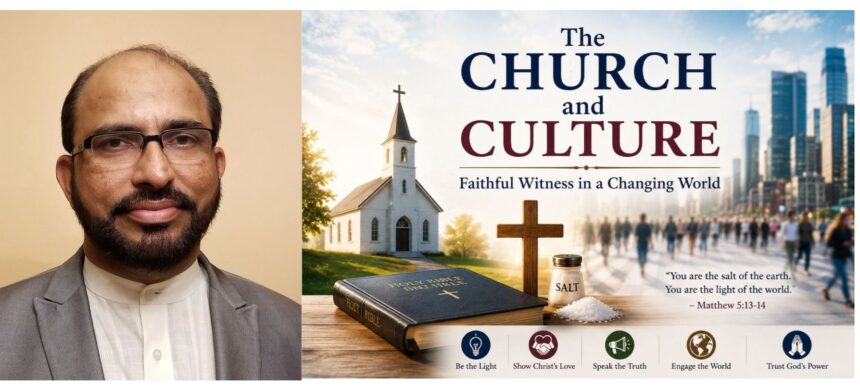
The Church and Culture: A Faithful Witness in a Changing World
Rev. Dr. Mathew Philip
Abstract:
The Church has always been present in culture but ultimately belongs to the Kingdom of God. From the Roman world of the first century to our own rapidly changing global society, Christians have faced the challenge of communicating the unchanging gospel in changing cultural contexts. Scripture does not call the Church to retreat fully from culture nor to conform to culture uncritically. Instead, believers are to engage culture faithfully to discern what can be affirmed, what must be challenged, and what can be transformed by the gospel. The article considers the biblical relationship between the Church and culture. It focuses on Christ’s call to be salt and light, the dangers of cultural conformity and isolation, the importance of contextualizing the gospel without compromising its truth, and the responsibility of the Church to offer a faithful, compassionate, and prophetic witness in changing times.

Introduction:
Every church exists within a culture. Christians live and minister in communities that are influenced by language, family structures, music, technology, social customs, political systems, economic conditions, and moral values. Thus, culture is unavoidable. It is not a matter of whether the church will engage culture but how it will engage culture faithfully. Jesus prayed concerning His disciples, “They are not of the world, even as I am not of the world” but also “As you sent me into the world, I have sent them into the world” (John 17:16, 18). These words express the tension of Christian existence. The Church is in the world, but not of it. Thus the Church must face two opposite dangers: to retreat from society so completely that its witness becomes ineffective and to conform to society so completely that its distinctive Christian identity is lost. Faithful witness means that the Church must be biblical, Christ-centered, Spirit-empowered, and engaged with the world that God loves.
Cultural Awareness:
In general, culture is the shared beliefs, values, customs, symbols, practices, and ways of life through which communities make sense of the world. Culture is not evil itself. Human creativity, family life, language, art, music, education, and social relationships may be manifestations of God’s common grace and of humanity being created in the image of God. But sin affects every culture as well. Cultural values can foster greed, injustice, sexual immorality, violence, prejudice, idolatry, or self-centeredness. And they can’t go along with all the things their culture celebrates. The Church views culture through biblical discernment. Some cultural practices can be affirmed because they are in line with God’s truth. Others can be modified and utilized for Christian purposes. Some must be challenged because they are in opposition to God’s revealed will. This is the discerning attitude Paul had when he said, “Test all things; hold fast what is good. Refrain from every evil thing” (1 Thess 5:21-22).
Jesus and Cultural Engagement:
Jesus is the ultimate model of faithful engagement with culture. The incarnation is the eternal Son of God entering a particular human culture. He spoke the language of his people, shared in their social life, attended weddings and religious festivals, ate meals with others, and used familiar agricultural and domestic images in his teaching. Yet Jesus never allowed culture to determine truth. He challenged religious hypocrisy, social exclusion, abuse of power, materialism, and misreadings of God’s law. He welcomed the outcasts of society, and at the same time, called sinners to repentance and changed living. Jesus was therefore not culturally isolated or culturally controlled. He entered the world of people, but without giving up the truth of the kingdom of God. The Church is called to model this incarnational pattern: drawing near to people with compassion yet remaining faithful to the Word of God.
Salt and Light in the World:
Jesus described His followers in two powerful ways: “You are the salt of the earth… You are the light of the world” (Matt. 5:13–14). Salt influences what it touches. Light shines in darkness. Both images suggest involvement, not withdrawal. When the Church stands up for moral truth, promotes goodness, protects the vulnerable, strengthens families, practices justice, and shows compassion, it is salt. It is light in the way it shows Christ in its message and in the way it lives. Jesus continued, “Let your light so shine before men that they may see your good works and glorify your Father which is in heaven” (Matthew 5:16). So faithful cultural engagement must be both proclamation and demonstration. The gospel is preached in the words of the Church and lived out in the holy and loving lives of its members.
The Risk of Cultural Conformity:
One of the greatest dangers to the Church is to allow culture to reshape Christianity instead of allowing the gospel to challenge culture. Paul warns us, “Do not be conformed to this world, but be transformed by the renewing of your mind” (Rom. 12:2). Cultural conformity can be gradual. Success could be measured in popularity, wealth, influence, entertainment, and social acceptance, rather than faithfulness to Christ. When the moral convictions of society clash with Scripture, the Church must be faithful even when biblical teaching is unpopular. The gospel cannot be modified simply to make Christianity culturally acceptable. But the truth of God is above all cultures and calls all societies to repentance and change. But faithfulness must not become hostility. Christians are called to “speak the truth in love” (Eph. 4:15). Biblical conviction and Christlike compassion are twin pillars.
The Risks of Cultural Isolation:
The other danger is to withdraw altogether from culture. Fear of compromise can lead to churches being inward-focused communities, alienated from the people they are meant to serve. But Jesus did not pray for His disciples to be taken out of the world but rather to be kept from evil in the world while doing their work in the world (John 17:15). Paul’s ministry shows cultural engagement. In Athens, he observed the city’s religious life and used an altar dedicated “TO THE UNKNOWN GOD” as a starting point for proclaiming the true God (Acts 17:22–31). Paul reached his audience without diluting his message. The modern Church, in turn, must know the questions, fears, hopes, technologies, and communications styles of the people it seeks to reach. Listening to culture does not mean surrendering to culture; it enables the Church to communicate the gospel meaningfully.
The Unchanging Gospel in Changing Forms:
The gospel message does not change, but the way it is communicated may. Over the centuries, Christians have announced Christ through preaching, literature, music, education, hospitals, mission movements, radio, television, and digital media. Properly utilized, new cultural forms can be instruments of the mission of God. This principle is often referred to as “contextualization”—communicating the unchanging gospel in ways that people in a particular culture can understand. Healthy contextualization asks, “How can we communicate biblical truth clearly in this culture?” Unhealthy accommodation asks, “How can we change Bible truth so the culture will accept it?” That’s an important difference. The Church must be flexible in method but faithful in message.
A Prophetic Voice to Culture:
The Church is also called to a prophetic ministry. Biblical prophets announced God’s truth to individuals as well as to communities, rulers, and nations. The Church must be bold to confront the questions of human dignity, injustice, exploitation, poverty, violence, corruption, family life, moral responsibility, and the care of the vulnerable. Yet the prophetic witness of the Church must never become simply partisan or ideological. Its ultimate loyalty is to Jesus Christ, not to any political party, social movement, or national identity. The church must be prepared to question every ideology that contradicts the gospel. Its credibility as a prophet depends on living up to the truth it preaches.
Cultural Witness:
Perhaps the Church’s most powerful cultural witness is a community that genuinely lives differently. Jesus said, “By this all will know that you are My disciples, if you have love for one another” (John 13:35). Such a congregation characterized by reconciliation, generosity, faithfulness, hospitality, racial and social fellowship, care for the suffering, respect for human dignity, and sacrificial love is a powerful alternative to a fractured society. The uniqueness of the Church should not be known by what Christians oppose but by who they follow and how they live. Holiness without love may become legalism. Love without truth can become compromise. Christian witness calls for both.
Faithful Witness in the Digital Era:
The growth of digital technology and social media is one of the big cultural shifts of our time. The Church today has unprecedented opportunities to cross geographical boundaries in communicating the gospel. But digital culture has its issues too: misinformation, polarization, unhealthy comparisons, superficial relationships, addiction to attention, and angry communication. Christians have to take their discipleship into digital spaces. The same biblical standards of truthfulness, kindness, self-control, purity, and love apply to the Internet. Technology should serve the Church’s mission and not dominate its spiritual life. Digital communication can complement Christian community, but it should not substitute for embodied fellowship, worship, pastoral care, and face-to-face relationships.
The Church as a Countercultural Community:
The Church is not simply criticizing culture; it is modeling an alternative way of life. It is a community shaped by God’s kingdom. Where society promotes self-interest, the Church must seek the interests of others (Philippians 2:4). Where society promotes revenge, Christians practice forgiveness. Where society divides, the gospel unites. In a society where people are measured by status, Christ teaches servant leadership. Where despair dominates, the Church proclaims resurrection hope. In this sense the Church is a countercultural community, not one that rejects society but one that lives by the values of the Kingdom of God.
Summary:
The Church is called to demonstrate wisdom, courage, and spiritual discernment in its relationship with culture, avoiding both withdrawal and complete surrender to worldly influences. Its core message remains that Jesus Christ is Lord, the source of salvation through His death and resurrection, and this eternal gospel needs to be communicated meaningfully to new generations and evolving societies. The Church listens, engages, serves, and speaks truthfully without compromising its values. Believers are encouraged to embody an alternative lifestyle characterized by holiness, compassion, justice, reconciliation, and hope. The Church, grounded in Scripture and empowered by the Holy Spirit, can face changing times without fear because the foundation does not change. Cultures rise and fall, social values shift, and generations come and go, but “Jesus Christ is the same yesterday, today, and forever” (Heb. 13:8). Faithful to this unchanging Christ, the Church can engage every culture with confidence, humility, and hope until He comes again.