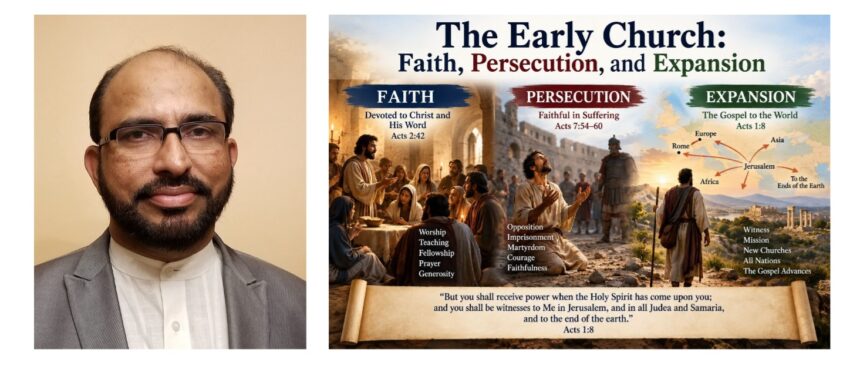
The Early Church: Faith, Persecution, and Growth
Rev. Dr. Mathew Philip
Abstract:
The story of the early Church is a fascinating story of faith, persecution, and missionary expansion. Christianity began as a small group of disciples in Jerusalem and spread throughout the Roman world in a matter of generations. This growth happened not because of political power, military force, or material riches. It happened because of the empowering presence of the Holy Spirit, the faithful preaching of the gospel, the sacrificial Christian community, and brave witness in the face of persecution. The book of Acts tells the story of the early stages of this expansion, and the New Testament letters tell the story of communities learning to live faithfully in different cultural contexts. Persecution time and again assailed the Christian message, but suffering was often an occasion for wider mission. This article examines the faith of the earliest Christians, the persecution they suffered, the missionary expansion of the gospel, and the lasting lessons that the early Church offers to the modern Church.

Introduction:
The Christian Church started in circumstances that seemed very insignificant from the point of view of worldly power. Jesus had been crucified by Roman authority; His followers were few in number, had no political influence, and had no military strength. Yet within a few centuries the Christian faith was widespread throughout much of the Roman Empire and beyond. The reason for this incredible expansion is not mostly in human strategy but in the work of God. The risen Christ commissioned his disciples, and the Holy Spirit empowered them for their witness. Before His ascension, Jesus declared, “You shall receive power when the Holy Spirit has come upon you; and you shall be witnesses to Me in Jerusalem, and in all Judea and Samaria, and to the end of the earth.” (Acts 1:8). This verse establishes the theological and geographical setting for the book of Acts. The gospel went out from Jerusalem to Judea and Samaria and then to the larger Gentile world. The early Church was formed by three realities: faith in the risen Christ, faithfulness in the face of persecution, and Spirit-empowered expansion of the gospel.
Pentecost and the Emergence of a Witnessing Community:
Pentecost was a turning point in the history of the Church. The Holy Spirit came upon the disciples with extraordinary power when they were in Jerusalem (Acts 2:1–4). Now Peter, who had denied Jesus, boldly proclaimed His death and resurrection. About three thousand responded to the message and were baptized (Acts 2:41). Soon the Church became a worshiping and witnessing community. Acts 2:42 mentions four practices of the earliest believers: the apostles’ teaching, fellowship, breaking of bread, and prayers. It was not a faith of individuals. It established a new community of believers in Christ.” They gathered together to worship, shared what they had, cared for those in need, prayed together, and spoke up for Jesus. This combination of spiritual devotion and community life gave credibility to their witness. And the gospel they preached was tangible in the community it created.
Faith Centered on the Risen Christ:
The belief that Jesus Christ had risen from the dead was central to the early Christian faith. The apostles did not preach, in the first place, a philosophical system or a program of morality. They proclaimed a man, Jesus Christ, crucified and risen. Peter said at Pentecost, “This Jesus God has raised up, of which we all are witnesses” (Acts 2:32). The resurrection changed frightened disciples into bold witnesses. They had seen the risen Christ, and they had no doubt that death had been overcome. This faith in the resurrection was pervasive in all of early Christianity. Because Jesus lived, believers could confront suffering without despair. Because Christ had conquered death, martyrdom could not destroy their hope. So their faith was historical as well as eschatological. They looked back to the cross and resurrection and forward to the return of Christ and the final establishment of God’s Kingdom.
The Dawn of Persecution:
Soon there was opposition. Peter and John were arrested for healing a lame man and preaching about Christ in Jerusalem (Acts 3-4). Religious authorities ordered them to stop teaching in the name of Jesus. Their answer exhibits the courage of the early Church: “We cannot but speak the things which we have seen and heard” (Acts 4:20). But the apostles knew that obedience to God was more important than their own safety. The opposition grew stronger. The apostles were put in prison and beaten. Stephen, one of the first servants and witnesses of the Church, was stoned for boldly proclaiming Christ (Acts 7). Stephen was the first Christian martyr on record. But even in death he mirrored the character of Jesus. He prayed for those who were killing him, “Lord, do not hold this sin against them” (Acts 7:60). The Church early learned the Christian witness could be expensive.
Persecution as a Tool for Expansion:
Stephen’s death was followed by a general persecution of the church at Jerusalem. Saul, who later became the apostle Paul, actively participated in the campaign against Christians. But persecution had an unforeseen result. Acts 8:4 states, “Therefore those who were scattered went everywhere preaching the word.” The Church’s enemies wanted to silence Christianity, but instead they helped spread the gospel beyond Jerusalem. Philip went down to the city of Samaria and preached the gospel there. Later he explained the Scriptures to an Ethiopian official who believed and was baptized. The gospel was breaking geographical, ethnic, and cultural boundaries. This pattern became one of the remarkable features of early Christian history: often what threatened the Church became an opportunity for mission.
The Mission and Conversion of Paul:
Few events contributed more to the spread of Christianity than the conversion of Saul of Tarsus. Saul began as a zealous persecutor of Christians. On his way to Damascus to arrest believers, he met the risen Christ (Acts 9). The persecutor became a preacher. Paul became the foremost missionary to the Gentile world. His missionary tours carried the gospel through Asia Minor and Macedonia and Greece and at last to Rome. Paul would typically enter a large city, preach Christ in the synagogues and in public, gather the believers, plant local churches, train leaders, and then move on to new areas. Churches were established in strategic cities like Philippi, Thessalonica, Corinth, and Ephesus. These congregations became centers from which the gospel spread to surrounding regions.
The Gospel Crosses Cultural Barriers:
The inclusion of Gentiles was one of the great challenges facing the early Church. At first, most believers were Jewish. But God showed through Peter’s encounter with Cornelius that the gospel was for all nations (Acts 10). The Jerusalem Council in Acts 15 became a crucial moment. Church leaders met to decide whether Gentile converts had to observe Jewish ceremonial laws so as to be full members of God’s people. The decision affirmed salvation in the grace of Jesus Christ and not in ethnic identity or observance of Mosaic law. This theological clarity paved the way for tremendous missionary expansion. The Church became more and more what Christ intended, a multinational, multicultural people united by faith in Him.
The Power of Christian Fellowship:
The increase of early Christianity was not due to preaching alone. The Christian community itself became a powerful witness. The believers took care of widows, helped the poor, practiced hospitality, shared their goods, received strangers, and treated one another as brothers and sisters. Christian congregations drew together people from different social and ethnic backgrounds in the deeply stratified world of Rome. Thus Paul could say, “You are all one in Christ Jesus” (Gal 3:28). This new community showed the transforming implications of the gospel. The New Testament letters show us that Christians were not perfect. Churches were plagued with conflict, theological confusion, moral failure, and leadership struggles. But the apostles continually called believers back to holiness, unity, forgiveness, and Christlike love.
Persecution in the Roman Empire:
As Christianity spread, opposition from the Roman authorities grew. Christians could be viewed with suspicion because they did not worship the emperor or take part in some of the religious activities that were part of Roman civic life. They confessed “Jesus is Lord” as a final allegiance to a power greater than political authority. Persecution was by no means uniform in time and place. Some were relatively peaceful, others were times of great suffering. Christians were jailed, their property confiscated, excluded from society, tortured and martyred. But time after time persecution could not destroy the Church. The courage of Christian martyrs showed that their hope was stronger than their fear of death. Their willingness to suffer rather than deny Christ was a powerful testimony to the depth of their faith.
Why Did the Early Church Grow?
Many factors contributed to the great growth of early Christianity. First, the Church had a firm conviction about the resurrection of Jesus Christ. Secondly, the believers relied on the power of the Holy Spirit. Third, average Christians were involved in spreading the gospel. Mission was not the business of apostles and professional ministers alone. Fourth, Christian communities showed love, generosity, holiness, and care for the vulnerable. 5. The Church has adapted its communication to different cultural contexts, but without neglecting the fundamental message of Christ. Finally, persecution frequently purified the church and scattered believers into new missionary fields. The expansion of Christianity was therefore not simply an institutional achievement. It was the result of faithful people carrying the gospel wherever God placed them.
Lessons for the Contemporary Church:
The early Church has important lessons for Christians today. First, the Church must be Christ-centered. Programs, buildings, institutions, and technology—all are valuable. But none can replace the gospel of the crucified and risen Lord. Second, the Church needs the power of the Holy Ghost. The work that Christ calls us to cannot be accomplished by human strength alone. Third, all believers are witnesses. The early church grew not only through the apostles but also through the ordinary Christians who shared their beliefs. Fourth, suffering does not have to destroy mission. God can use adversity to strengthen our faith and to open up unexpected opportunities for witnessing. Fifth, the Christian community matters. The gospel becomes visible in a church of love, generosity, holiness, and reconciliation. Finally, mission is a boundary-crossing activity. The gospel is for every people group, language, culture and nation.
The Early Church as the Biblical Model for All Time:
The early church is the model for the church in every generation. It was apostolic in its foundation and Pentecostal in its nature—committed to the apostles’ teaching, focused on the death and resurrection of Jesus Christ, and empowered, directed, and endowed by the Holy Spirit. Acts 2 describes a community marked by the Word, the Spirit, prayer, fellowship, worship, spiritual gifts, compassionate sharing, evangelism, and missionary witness. Apostolic, therefore, is to be faithful to the gospel and teaching committed to the apostles; Pentecostal, to live in continuous dependence on the presence and power of the Holy Spirit. The Church today is healthiest when these dimensions are held together: anchored in apostolic truth, filled with the Spirit of Pentecost, centered on Christ, and sent into the world in mission.
Summary:
The early Church’s narrative illustrates a journey of faith that faced persecution yet thrived through expansion. Beginning with a small group of disciples in Jerusalem, the gospel spread outward, fueled by the Holy Spirit, overcoming obstacles such as imprisonment, violence, cultural challenges, and political opposition. Lacking modern resources like grand buildings or mass media, early Christians relied on fundamental elements: faith in the risen Christ, the Holy Spirit’s power, devotion to apostolic teachings, fellowship, courage in suffering, and a commitment to the Great Commission. Their resilience serves as a reminder to contemporary churches that strength does not depend on favorable conditions; the gospel remains robust even in adversity. Persecution may have scattered believers, yet they carried Christ with them, finding endurance through the hope of resurrection. Cultural barriers were transcended as the Holy Spirit opened doors to various nations. The early Church thus exemplifies ongoing faithful mission work, with the same risen Christ sending His Church today. Empowered by the Holy Spirit, God’s people continue to witness, proclaiming the unchanging gospel that began in Jerusalem and extends to all generations. The Church’s call remains: to believe courageously, suffer faithfully, boldly proclaim Christ, and spread the gospel to every nation until the Lord’s return.