Pentecost and the Birth of the Church: The Spirit Forms a New Community
Rev. Dr. Mathew Philip
Abstract:
Pentecost is one of the decisive events in the history of salvation. The outpouring of the Holy Spirit recorded in Acts 2 is not just an extraordinary spiritual experience but the public birth of the Church as a Spirit-empowered, Christ-centered, and mission-oriented community. The praying disciples were bold witnesses of the risen Christ, and the gospel drew people from many nations into one new fellowship. In this article, Pentecost is seen as the birth of the Church and the ministry of the Holy Spirit in the formation of a new community of unity, proclamation, repentance, fellowship, worship, and mission.
Introduction:
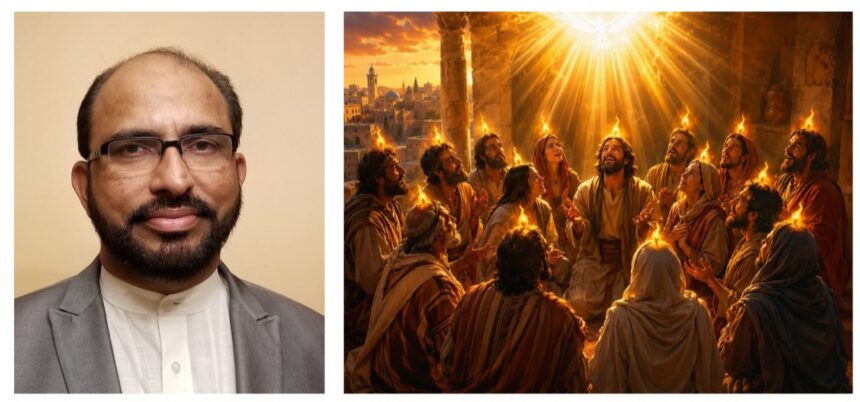
The Church was not born as an institution of people, a social reform movement, or an organizational strategy. It was birthed in the sovereign act of God at Pentecost. Then, after His resurrection, Jesus told His disciples not to leave Jerusalem but to “wait for the Promise of the Father” and said, “You will receive power when the Holy Spirit comes on you; and you will be witnesses of me” (Acts 1:4, 8). And the disciples obeyed and gathered in prayerful expectation. Then on the day of Pentecost, the Holy Spirit came upon them with the sound of a rushing mighty wind, tongues of fire, and Spirit-enabled speech in languages understood by the gathered crowds. Pentecost was not a one-off miracle. It was the fulfillment of the divine promise, the continuation of Christ’s redemptive mission, and the beginning of the Church’s life in the age of the Spirit. From that day forward, the followers of Jesus would not be a group of disciples remembering their Teacher. They would become the living body of Christ, empowered by the Holy Spirit to bear witness to the gospel throughout the world.
Pentecost: The Fulfillment of God’s Promise:
We must understand the Pentecost events in the larger story of Scripture. The Old Testament, again and again, looked ahead to a coming outpouring of the Spirit. God had promised through the prophet Joel, “I will pour out My Spirit on all flesh” (Joel 2:28). Ezekiel talked about a day when God would give His people a new heart and put His Spirit within them (Ezek. 36:26-27). These promises looked forward to a new time when God would not only be present in a temple or with a few leaders, but with His people. Peter explicitly interpreted Pentecost in light of Joel’s prophecy, saying, “This is what was spoken by the prophet Joel” (Acts 2:16). The coming of the Spirit meant that the long-awaited age of fulfillment had arrived. Jesus’ death, resurrection, and exaltation made possible the pouring out of the promised Spirit on God’s people. Pentecost, then, shows that the Church is not merely a continuation of human religious aspiration but the consequence of God’s covenant faithfulness. The Church is here because God fulfills his promises. The descent of the Spirit is the divine mark that the messianic age has begun and that the mission of Christ is now being carried on through His people.
The Spirit Forms a New Community:
One of the most important characteristics of Pentecost is that the Holy Spirit builds a faith community. The Spirit does not just energize individual persons for personal spiritual experience; He creates a new community of people founded on Jesus Christ. Before Pentecost the disciples were scared, confused, and hiding behind closed doors. After Pentecost they became bold witnesses of God’s mighty works and publicly proclaimed them. Peter, who had before denied Christ, now stood before the crowd and declared with conviction that Jesus, whom they had crucified, had risen from the dead and was made both Lord and Christ. The Spirit made cowards apostles. The result of Peter’s Spirit-empowered preaching was staggering: “So those who accepted his message were baptized, and about three thousand were added to their number that day” (Acts 2:41). “Added to them” is an important phrase. Conversion was not just personal forgiveness; it was inclusion in a community. Those who responded to the gospel were incorporated into the newly formed Church. This new community was not based on ethnicity, class, or national identity. The audience in Jerusalem included Jews and proselytes from many parts of the known world. By the Spirit the gospel was preached in their own tongues, a sign that God’s redemptive purpose was now reaching out to all nations. Pentecost anticipates the church’s catholicity. The Spirit unites many peoples into one people, one body in Christ.
The Reversal of Babel:
Theologically, Pentecost also contrasts with the Tower of Babel in Genesis 11. At Babel, human pride resulted in confusion of language and scattering of peoples. At Pentecost the Holy Spirit made it possible for the message of God to be heard across linguistic boundaries, bringing people together around the saving work of Christ. Pentecost does not eliminate cultural or linguistic diversity. Instead, it demonstrates that the good news can be proclaimed in all languages and cultures. It was not a miracle that all spoke one language but that each person heard “in our own language in which we were born” (Acts 2:8). The Spirit does not produce uniformity; He produces unity in diversity. This is foundational for understanding the Church. The Church is not a culturally narrow community, but a Spirit-created people drawn from every nation, tribe, and tongue. Its unity is not in sameness of background but in shared faith in Jesus Christ. Pentecost thus gives a theological basis for global mission, intercultural fellowship, and a vision of the Church that moves beyond ethnic and social boundaries.
The Marks of the Pentecostal Community:
The Spirit-formed Church is beautifully pictured in Acts 2:42-47. These believers “continued steadfastly in the apostles’ doctrine and fellowship, in the breaking of bread, and in prayers.” This new community displays a number of signs. First, the Church was devoted to apostolic teaching. The Spirit who inspired the Scriptures also guides the Church into the Truth. The Church that is filled with the Holy Spirit is not divorced from doctrine; rather, it is grounded in the teaching of Christ proclaimed by the apostles. Secondly, the Church was committed to fellowship. They lived their faith in relationships of sharing, mutual care, and spiritual communion. The Church was not a collection of religious spectators, but a family of believers united in Christ. Third, they shared in the breaking of bread, which probably meant both eating meals together and remembering Christ’s death in the Lord’s Supper. Worship and table fellowship were at the center of their life together. Fourthly, they were given to prayer. The Church that was born in prayer was kept in prayer. Pentecost was not the end of dependence on God but the beginning of a prayer-sustained community. Fifth, the Spirit produced generosity and care for one another. Believers shared their resources so that needs were met. It was not compulsory collectivism but voluntary love flowing from changed hearts. Finally, the Church was marked by joy, praise, and missional vitality. They glorified God and had favor with all the people. And the Lord added to the church daily those who were being saved (Acts 2:47). The Spirit created a community that was internally nurturing and externally witnessing.
The Missionary Nature of the Church:
Pentecost shows that the Church is missionary by its very nature. Jesus had already stated the purpose of the Spirit’s empowering: “You shall be witnesses to Me” (Acts 1:8). The Spirit does not come just to comfort (though He does comfort) but to empower the Church for witnessing. The book of Acts follows the geographical course of this mission: Jerusalem, Judea, Samaria, and the ends of the earth. The Spirit sends the Church outwards; the Church moves outwards. So Pentecost is the start of the Church’s mission to the whole world. The missional identity has to be present in all authentic expressions of the Church. A church for itself only forgets the purpose of Pentecost. The Spirit gathers a community that worships God, grows in holiness, loves one another, and witnesses to Christ in the world.
Pentecost and the Ongoing Life of the Church:
Pentecost was a special event in history, but its theological significance still exists. The Church today continues to depend on the Holy Spirit for life, unity, holiness, and mission. No amount of organizational efficiency can ever replace spiritual empowerment. Programs may get attention, but only the Spirit brings about real change. Human eloquence may persuade, but Spirit-anointed proclamation brings conviction, repentance, and new birth. The Church must return again and again to the lessons of Pentecost: waiting on God, seeking the fullness of the Spirit, proclaiming Christ boldly, welcoming people across barriers, and cultivating deep fellowship rooted in the gospel. Pentecost is a reminder to believers that the Church is built not on human strength but on divine power.
Summary:
Pentecost is the birth of the Church and the beginning of a new age of God’s plan of redemption. The Holy Spirit came down on the disciples, enabling them to witness, bringing a multitude to faith, and creating a new community of truth, fellowship, worship, prayer, generosity, and mission. The Church was born not of human design but of divine initiative. The Spirit who formed the Church at Pentecost continues to give it life and to guide it today. The Church is most faithful to its calling when it lives as a Spirit-filled, Christ-centered, need-oriented, and mission-driven community. Pentecost is therefore not only the memory of the beginning of the Church but also an ongoing call to live in the power, unity, and purpose of the Holy Spirit until Christ comes again.