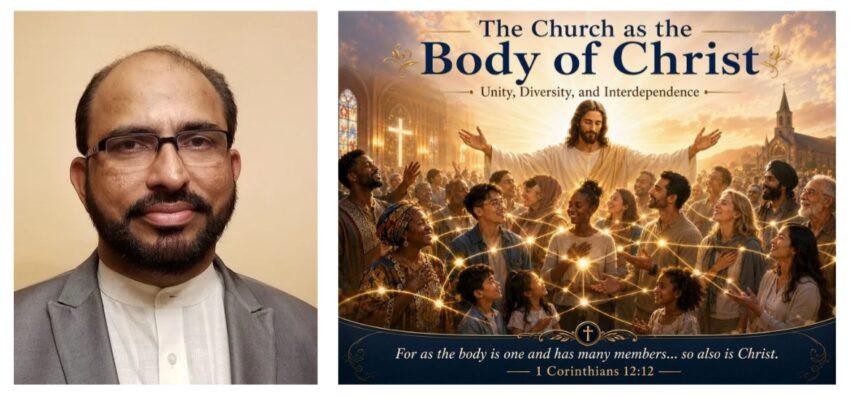
The Church as the Body of Christ: Unity, Diversity, and Interdependence
Rev. Dr. Mathew Philip
Abstract:
One of the most powerful images of the Church in the New Testament is Paul’s description of the believers as the Body of Christ. This metaphor reveals that the Church is not simply an organization, an institution or a group of people but a living spiritual body united to Christ and to each other. In this article, especially using 1 Corinthians 12, Romans 12, and Ephesians 4, I will discuss three essential aspects of the Church as the body of Christ: unity, diversity and interdependence. The Church is one in its one Lord, one Spirit, and one faith; it is diverse in the gifts, roles, and callings of its members given by God; and it is interdependent because each believer is needed for the health and mission of the whole body. This biblical vision is in contrast to individualism, division, competition, and spiritual isolation. The Church is called to be Christ’s presence in the world through mutual love and shared ministry.
Introduction:
The Church is often described as a congregation, denomination, community of worship, or ministry organization, but none convey its spiritual essence as deeply as the biblical notion of the Body of Christ. The apostle Paul’s declaration in 1 Corinthians 12:27 emphasizes the theological and pastoral nature of believers being united with Christ and one another, fostering a relationship of shared life, responsibility, and purpose. This body imagery highlights the Church’s vitality, connection, and cooperation; it represents a living whole comprised of diverse members who are interdependent and unified through the Holy Spirit. Amidst a world marked by fragmentation and individualism, the doctrine of the Body of Christ offers a compelling vision of Christian community, asserting that unity does not equate to sameness, diversity does not imply division, and interdependence is not a sign of weakness but a divine design for His people.
Christ the Head of the Body:
Any discussion of the Church as the Body of Christ must start with Christ Himself. Paul writes that Christ “is the head of the body, the church” (Colossians 1:18). The Church does not exist apart from Him. Its life, authority, direction, and purpose come only from Christ. As the head rules the human body, so Christ rules His Church. He is not merely an honored founder from the past but the living Lord who continues to guide, nourish, and sustain His people. Ephesians 4:15-16 says the whole body is joined and held together by every joint and supplies, and it grows “from Him,” the Head. This means that real spiritual growth cannot be divorced from a living relationship with Christ. Whenever the Church loses its center in Christ it becomes unhealthy. When personalities, traditions, politics, or institutional ambitions take precedence over the lordship of Christ, the body is not rightly aligned. A Christ-centered Church hears His word, follows His example, obeys His commands, and seeks His glory above all else.
The Unity of the Body:
Paul’s body metaphor in 1 Corinthians emphasizes the essential unity of believers in Christ, asserting that, despite their diverse functions and backgrounds, they comprise one body. This unity is not achieved through mere agreement but is inherently a result of their union with Christ, facilitated by the Holy Spirit. Paul highlights that all believers, regardless of race, class, or culture, are baptized into one body by the same Spirit, thereby forming a deeper identity in Christ that transcends individual histories. Today, the Church is encouraged to uphold this teaching, resisting divisions based on race, language, nationality, age, education, or status. The emphasis is on a unity that is reflective of divine grace, fostered by love, and distinct from societal divisions. Paul calls for believers to actively maintain this unity through humility, patience, and forgiveness, placing the well-being of the Church community above personal pride. Such unity is not achieved by compromising truth or doctrine but by living under the lordship of Christ and fostering an environment of peace and mutual support within the congregation. Ultimately, the Church is tasked with embodying and demonstrating a unity that the world cannot provide.
The Diversity of the Body:
Paul emphasizes the importance of unity within the Church while acknowledging its intrinsic diversity. He uses metaphors to illustrate that if the Church were solely comprised of one function, such as an eye or an ear, it would lack completeness and effectiveness. This diversity, encompassing various spiritual gifts and talents—teachers, encouragers, leaders, and servants—serves as a divine design intended for the benefit of the whole community, as highlighted in Romans 12:4-8 and 1 Corinthians 12:4-11. The differentiation among members acts as a safeguard against uniformity, ensuring that no single individual possesses every gift or that any one ministry can fulfill the entirety of the Church’s mission. A thriving congregation acknowledges and nurtures contributions from all members, emphasizing the value of even the less visible services while addressing feelings of inadequacy that may arise from comparisons. Paul warns against such attitudes, reinforcing that all members are interconnected and essential to one another, as illustrated in his assertion that no part of the body can exist independently. This interconnectedness affirms that every member holds dignity, derives purpose from their belonging to Christ, and plays a vital role in the community. Ultimately, the call is towards a collective endeavor wherein each diverse function harmoniously contributes to a unified purpose.
The Interdependence of the Body:
The concept of the body as a metaphor for the Church illustrates the interdependence of its members, emphasizing that believers are not only related but fundamentally connected. Each part of the body serves the whole, stressing that members of the Church are called to care for, support, and strengthen one another, as highlighted in 1 Corinthians 12:25. The message underscores a strong vision of Christian solidarity: if one member suffers, all suffer together, and if one is honored, all rejoice. This perspective challenges the contemporary tendency towards spiritual independence, as many Christians view faith purely as a personal journey with minimal accountability to a local church community. However, the New Testament presents a different narrative that emphasizes communal connectivity among believers. They require ongoing mutual teaching, encouragement, correction, prayer, fellowship, and worship to foster spiritual maturity. This interdependence also extends to ministry within the Church. Ephesians 4:11-12 denotes that the work of ministry is not exclusive to pastors and leaders but is a collective responsibility shared among all members. Each believer is called to contribute to the Church’s growth and health according to the unique grace gifts they possess, reinforcing the idea that every Christian plays a vital role in building up the body of Christ.
Love as the Life of the Body:
Paul moves to the “more excellent way” of love in 1 Corinthians 13 after his discussion of spiritual gifts in 1 Corinthians 12. This positioning is of great importance. Gifts without love are just noise; service without love is empty; knowledge without love becomes pride. Love is a moral and spiritual atmosphere in which the body can work well. Therefore, the Church as the Body of Christ must be characterized by self-giving love. Christ loved the church and gave himself for it (Eph. 5:25). His body on earth is called to mirror that same sacrificial love in its relationships. Love preserves unity. Love loves variety. Love is the practice of interdependence. A gifted Church without love can be divisive, competitive, and self-promoting. But a loving Church uses every gift to edify others and to glorify Christ.
Summary:
The image of the Church as the Body of Christ is a rich, needed vision for Christian life and ministry. The Church as one body is one because it is united under one Head, Jesus Christ. It is a diverse body, for the Holy Spirit gives different gifts and callings to the believers. It is an interdependent body, for each member is necessary for the health, maturity and mission of the whole. This truth invites the Church to overcome division, isolation and self-absorption. It challenges believers to receive one another as members of the body of Christ, to appreciate diverse gifts, to bear each other’s burdens and to serve each other in love. When the Church lives this way, it is a visible sign of Christ’s life in the world, a community of unity, rich in diversity, and strong in mutual care.