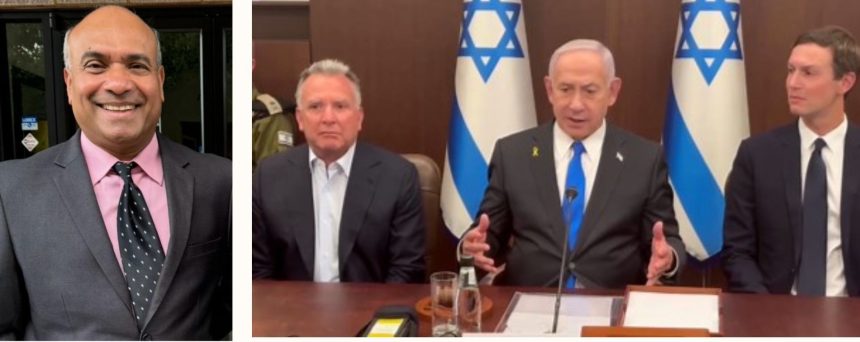
Rev. Shaji Karackal
New York: As of October 10, 2025, Israel and Hamas have reached and approved the initial phase of a U.S.-brokered ceasefire agreement aimed at ending the two-year war in Gaza. This breakthrough, announced by President Donald Trump on October 9, involves the release of all remaining Israeli hostages held by Hamas in exchange for thousands of Palestinian prisoners, a partial Israeli military withdrawal from Gaza, and an influx of humanitarian aid. The deal marks a significant diplomatic push by Trump’s administration, with key roles played by special envoy Steve Witkoff and Trump’s son-in-law, Jared Kushner, alongside Israeli Prime Minister Benjamin Netanyahu. Reaction from most Muslim nation’s are a big sigh of relief or the least a muted reaction which is very telling.
The agreement, part of Trump’s broader 20-point peace plan unveiled last month, focuses on immediate de-escalation and hostage recovery. Hamas to release all ~48 remaining Israeli hostages (20 believed alive, plus deceased) within 72 hours of ceasefire activation. Expected early next week. Israel to free ~2,000 Palestinian prisoners, including high-profile figures like Marwan Barghouti. Final list under negotiation. Israeli forces to pull back to control ~47% of Gaza (from current positions near Gaza City), within 24 hours of approval. Full withdrawal tied to Hamas disarmament in later phases. 400 aid trucks/day for first 5 days, ramping to 600/day thereafter. Monitored by a U.S.-led multinational force (~200 troops from Egypt, Qatar, Turkey, UAE; no direct U.S. ground presence).
The plan envisions Gaza’s demilitarization, Hamas disbandment, and international governance (potentially overseen by Trump and former UK PM Tony Blair). However, long-term issues like Gaza’s future administration remain unresolved, with Hamas demanding a full Israeli exit and no disarmament without guarantees.
Benjamin Netanyahu: Secured cabinet approval after a marathon ~7-hour session on Oct. 9, crediting “combined military and diplomatic pressure” on Hamas. He paused the meeting for a call with Indian PM Narendra Modi, who congratulated him on the deal. Netanyahu thanked Trump, Witkoff, and Kushner directly during the session, calling the agreement a step toward Israel’s war aims. However, far-right allies like Itamar Ben-Gvir and Bezalel Smotrich opposed it, threatening to collapse the coalition unless Hamas is fully dismantled—potentially forcing elections by March 2026.
Steve Witkoff: As Trump’s special Middle East envoy, Witkoff led indirect talks in Egypt’s Sharm el-Sheikh starting Oct. 7, alongside mediators from Egypt, Qatar, and Turkey. He addressed Netanyahu’s cabinet, praising the PM’s “tough choices” on flexibility with Hamas. Witkoff, a real estate developer and Trump ally, emphasized no departure from Egypt without progress.
Jared Kushner: Returning unofficially as a “trusted voice” (architect of the 2020 Abraham Accords), Kushner joined Witkoff in Egypt on Oct. 8 after Oval Office strategy sessions with Trump. They met Netanyahu in New York (late Sept.) and Israel (Oct. 9), resolving gaps on withdrawal timelines and Israeli vetoes over Hamas disarmament. Kushner and Witkoff remained in Israel post-approval to ensure implementation.
Trump hailed the deal on Truth Social as a “first Phase” success, planning a Middle East visit (Egypt and Israel) for a formal signing. He met released hostage Edan Alexander on Oct. 8, underscoring personal stakes.