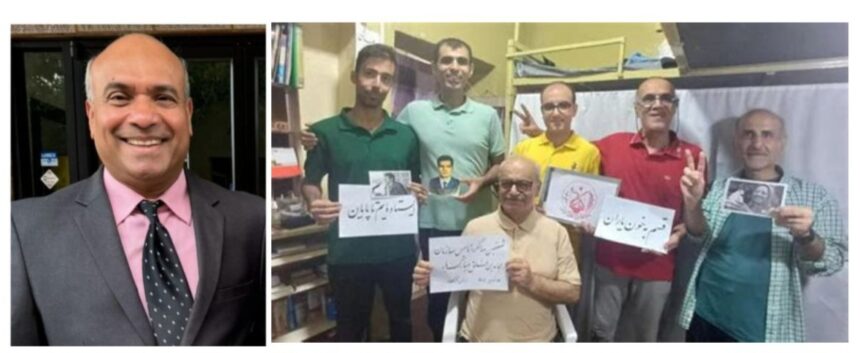
George Varughese
Tehran: In the shadow of Iran’s notorious Ghezel Hesar prison, six men stood shoulder to shoulder in a barren courtyard one crisp morning in late February 2026. Their hands were bound, their fates sealed by a regime that had branded them enemies for daring to dream of freedom. Yet as the nooses awaited them, they did not tremble in silence. Instead, they lifted their voices in a haunting, unbroken song—a final act of defiance that would echo far beyond the prison walls and stir the conscience of a generation watching from afar.
The smuggled video, captured secretly and later shared with the world, captures the raw power of their final moments. Vahid Baniamerian, Babak Alipour, Abolhassan Montazer, Pouya Ghobadi, Akbar Daneshvarkar, and Mohammad Taghavi—young dissidents in their prime, some just 33 years old—had been swept up in the deadly January protests that shook Iran to its core. What began as streets filled with cries for justice after years of oppression had turned into a bloodbath, with human rights groups reporting more than 7,000 lives lost in the crackdown. Charged with the capital crime of “waging war against God,” these six faced the gallows for actions the regime claimed threatened its iron grip.
But fear could not silence them. With calm resolve, they sang lyrics forged in the fire of resistance: “Your rival stands before you now, hardened in the flame—I am the faith, I am revolt, with belief I take my stand—I’ve sworn an oath upon my blood, the tyrant’s throne shall shatter.” Their voices, steady and united, rang out like a promise whispered to the wind. It was no desperate plea; it was a declaration. Baniamerian, who had earlier recorded a smuggled message directly challenging Supreme Leader Ayatollah Ali Khamenei, had once reminded the world: “I and those like me rose from the blood of freedom-loving youth.” Together with his brothers in arms, they had penned a manifesto from their cells, vowing that even if the regime executed them “hundreds of thousands of times,” their spirit of rebellion would endure for a democratic future.
The executions came swiftly in the weeks that followed—Ghobadi on March 31, Baniamerian on April 4—part of a grim surge in hangings that accelerated after Iran’s clashes with the U.S. and Israel. Yet in that video, their song transforms the horror into something transcendent. These were not faceless prisoners; they were fathers, sons, dreamers who had marched for dignity, for the right of women to uncover their hair, for a nation unchained from tyranny. Their final melody, now circulating online and inspiring protests worldwide, has become a rallying cry for Iran’s youth and sympathizers abroad. It speaks to a universal truth: no dictatorship can extinguish the human longing for liberty.
As the world grapples with the images—faces etched with quiet courage amid unimaginable dread—their voices linger like a torch passed to the next generation. In an era of fleeting headlines and digital noise, these six men remind us that true power lies not in weapons or walls, but in the unyielding song of the human spirit. The tyrant’s throne may yet shatter, just as they foretold, carried forward on the wings of their unbreakable faith.