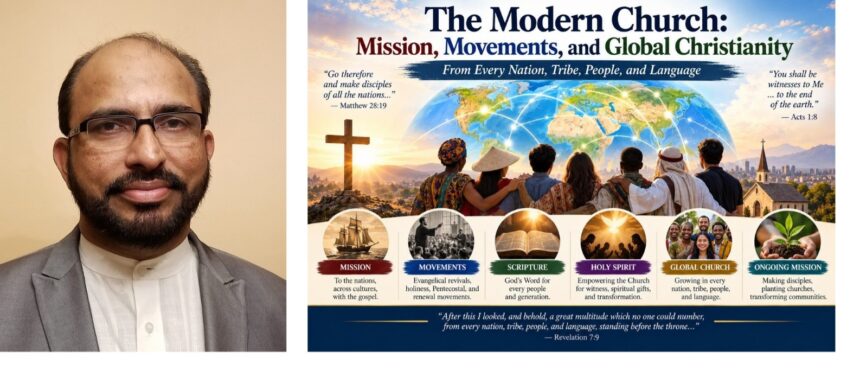
Rev. Dr. Mathew Philip
Continuing the “All About Church” series, this article explores the transformation of Christianity from its predominantly European institutional setting into a worldwide movement, highlighting missionary expansion, evangelical revivals, Pentecostalism, and the growth of Christianity in the Global South.
Abstract:
The modern period of church history shows an incredible transformation of the geographical, cultural, and spiritual landscape of Christianity. The Church has developed and diversified in the last two centuries, from the missionary movements of the eighteenth and nineteenth centuries to the emergence of evangelical revivals, Pentecostalism, indigenous churches, and modern global Christianity. Once institutionalized in Europe, Christianity has become a global faith with vibrant communities across Africa, Asia, Latin America, and the Pacific. It is part of the ongoing fulfillment of Christ’s Great Commission and the dynamic work of the Holy Spirit among cultures. Modern Christianity also faces its own issues of secularization, theological disintegration, cultural accommodation, religious persecution, and institutional decline in some parts of the world. The article examines the missionary expansion, renewal movements, Pentecostal awakening, and globalization of Christianity, highlighting the Church’s constant call to remain faithful to the Scriptures, empowered by the Holy Spirit, and committed to making disciples of all nations.
Introduction:
The history of the Church is the unfolding story of the redemptive mission of God through His people. Beginning on the Day of Pentecost in Jerusalem, the gospel crossed geographic, linguistic, cultural, and political boundaries. A small group of believers became a worldwide Christian movement. The modern era, particularly since the eighteenth century, has been marked by an unprecedented level of missionary activity, spiritual awakenings, the growth of denominations, and the emergence of indigenous Christian communities. Jesus said, “Go therefore and make disciples of all nations” (Matt 28:19). This mission is the foundation of the Church’s missionary identity. The church of today shows that Christianity cannot be confined to one nation, one culture, one race, one language, or one denomination. The gospel is for all of humanity, and the Church is called to proclaim Christ to all nations. Three major themes characterize this period: missionary expansion, movements of spiritual renewal, and the globalization of Christianity.
- The Rise of Modern Missionary Movements:
Christian missions had existed in earlier centuries, but the 18th and 19th centuries saw the emergence of Protestant missionary movements on a scale never before seen. The Moravian movement, under Count Nikolaus von Zinzendorf, showed an extraordinary dedication to missionary work. Moravian believers journeyed near and far, often enduring hardship and danger to proclaim Christ. In 1793, William Carey, often referred to as the father of the modern Protestant missionary movement, traveled to India. His ministry centered on evangelism, Bible translation, education, and social concern. Carey’s missionary vision helped Christians see that the Great Commission was still a responsibility of the whole Church. Missionary societies then emerged in Europe and North America, sending workers to Africa, Asia, Latin America, and the Pacific. These movements established churches, translated the Scriptures, developed schools, supported medical ministries, and promoted Christian literature. But missionary history was also entangled in uncomfortable links to colonial expansion and cultural paternalism. Faithful evaluation requires that we acknowledge both the missionary sacrifice and those occasions when Western cultural assumptions became confused with biblical Christianity. The gospel transcends every culture and must never be an instrument of cultural domination. - Evangelical Revivals and Spiritual Awakenings:
The modern Church was greatly influenced by evangelical revival movements. The 18th-century Great Awakening focused on personal conversion, biblical preaching, repentance, and the transforming power of the gospel. Preachers such as Jonathan Edwards and George Whitefield called people to a real faith, not just to a formal participation in religion. John Wesley and the Methodist movement emphasized salvation by grace, personal holiness, disciplined Christian living, and practical compassion. Such movements challenged spiritual complacency and reminded the Church that Christianity was more than an institutional membership. Jesus said, “No one can see the kingdom of God unless he is born again” (John 3:3). Revival movements stressed the need for personal regeneration and transformed living. They also promoted lay involvement, evangelism, singing of hymns, prayer meetings, Bible study, and missionary work. The Church was reminded that mere structures of organization are not enough to maintain spiritual vitality. It requires a living faith in Jesus Christ. - The Pursuit of Sanctification and the Holiness Movement:
Holiness movements arose in the nineteenth century within several Protestant traditions, especially those influenced by Wesleyan theology. The movements were focused on sanctification, personal holiness, prayer, spiritual discipline, and complete devotion to God. Instead of simply adhering outwardly to religious standards, believers were urged to live lives changed by the Holy Spirit. Peter writes, “Be holy, because I am holy” (1 Peter 1:16). The holiness movements stimulated a new interest in spiritual experience, evangelism, and the empowering work of the Holy Spirit. They also affected the theological and spiritual atmosphere from which modern Pentecostalism arose. The great contribution of their work was the conviction that the gospel changes not only eternal destiny for the believer but also everyday character and conduct. - The Pentecostal Movement and the Renewal of Spiritual Gifts:
One of the most influential developments in modern Christianity was the rise of the Pentecostal movement during the early twentieth century. The Azusa Street Revival in Los Angeles, which began in 1906 under the leadership of William J. Seymour, became a major catalyst for the worldwide expansion of Pentecostal Christianity. It also was shaped in part by earlier revivals, including the Topeka events of 1901. Pentecostal believers emphasized the baptism in the Holy Spirit, spiritual gifts, divine healing, prayer, holiness, evangelism, and the anticipation of the return of Christ. Acts 1:8 became a defining biblical foundation: “You shall receive power when the Holy Spirit has come upon you; and you shall be witnesses to Me.” Pentecostalism emphasized that the Holy Spirit, who empowered the apostolic Church, continues to equip believers for ministry. The movement spread quickly through missionary networks, local evangelists, indigenous leaders, and revival communities. In several established Protestant and Roman Catholic traditions, spiritual gifts were again emphasized by later charismatic renewal movements. In Pentecostal terms, the modern Church must be apostolic in doctrine, Pentecostal in spiritual life, holy in behavior, and missionary in purpose. - Christianity as a Global Faith:
One of the most important developments in modern Christianity has been its demographic shift to the Global South. Christianity has undergone secularization and institutional decline in parts of Europe and North America, but Christian communities have grown explosively in many parts of sub-Saharan Africa, Latin America, and Asia. Today’s Christianity around the world is strikingly diverse in language, worship, theology, and culture. Christianity can no longer be understood adequately from a primarily European or North American perspective. African churches, Asian Christian communities, Latin American evangelical movements, and indigenous Christian traditions are increasingly shaping global theological education, missions, worship, and leadership. This is the change that is envisioned in Revelation 7:9: “A great multitude which no one could number, of all nations, tribes, peoples, and tongues.” The universal Church is appearing more and more as a multicultural, multinational community. - The Rise of Indigenous Churches:
Indigenous Christian leadership also emerged during the modern missionary history. Early missions often depended heavily on foreign leadership, financial support, and organizational control. Churches developed local leadership, theological institutions, and missionary initiatives to an increasing degree over the years. The concepts of the self-governing, self-supporting, and self-propagating church were to have a great impact on missionary thinking. Indigenous churches show that Christianity does not belong only to one civilization. The gospel can be truly articulated in different languages, musical styles, cultural forms, and community structures and still remain biblical. Local believers are not just objects of missionary activity. They are essential participants in God’s global mission. - The Contemporary Church and Social Transformation:
Contemporary Christian movements also engaged in education, health care, humanitarian aid, and social reform. Christian organizations began schools, hospitals, orphanages, and ministries to help the poor and needy. Many believers were involved in movements against slavery, poverty, exploitation, and social injustice. The model is Jesus’ ministry, “But when He saw the multitudes, He was moved with compassion for them” (Matthew 9:36). The Church’s social responsibility is rooted in its commitment to the Gospel. But the humanitarian service must not take the place of the proclamation of salvation in Christ. Biblical mission involves proclaiming the gospel and demonstrating the compassion of Christ. - Technology and the Growth of Christian Mission
The Church today has used technological advances more in the communication of the gospel. The printing press had already revolutionized the dissemination of Scripture. Later, radio, television, audio recordings, and digital communication expanded the possibilities for evangelism and discipleship. Today, Christian teaching can cross geographical boundaries nearly instantaneously through online worship, digital Bible resources, theological education, social media, and global communication networks. These developments open up extraordinary missionary possibilities. But technology cannot replace real Christian fellowship, pastoral care, discipleship, or the embodied life of the local congregation. Technology must remain a servant of the Church’s mission rather than becoming its master. - Challenges Facing Global Christianity:
Today, in spite of its growth, the Church faces some big challenges. In some societies, secularization has weakened institutional Christianity. Elsewhere, there remains religious persecution. Consumerism, materialism, theological confusion, moral failure, and political polarization threaten the Church’s witness. The prosperity gospel can distort biblical teaching by reducing faith to promises of material success. Personality-centered leadership can be a distraction from accountability and the headship of Christ. Cultural nationalism can also tempt Christians to identify the gospel too closely with political or ethnic interests. These challenges remind believers that numerical growth does not always equal spiritual maturity. Paul urges the church to grow “to the measure of the stature of the fullness of Christ” (Ephesians 4:13). The true measure of the Church is not its size or influence but its faithfulness to Christ. - The Future of Global Christian Missions:
The modern Church is at a momentous point in the history of missions. Mission is increasingly multi-directional. Now, churches in Africa, Asia, and Latin America are sending missionaries to Europe, North America, and beyond. Global migration has brought about multicultural congregations and new opportunities for cross-cultural witness. The mission of the missionaries is not complete, and the Church still has the challenge of reaching people who have little access to the gospel. “And this gospel of the kingdom will be preached in all the world as a witness to all nations” (Matthew 24:14). The Church must therefore continue to invest in biblical teaching, theological education, discipleship, leadership development, church planting, compassion ministries, and missionary cooperation. Its methods and its geographical centers change, but its mission remains unchanged.
Summary:
The modern Church is a testimony to the phenomenal growth of Christianity across geographical, cultural, and denominational barriers. Missionary movements carried the gospel to new areas. Evangelical revivals focused on personal conversion and biblical faithfulness. Holiness movements produced sanctification and spiritual discipline. Pentecostal and charismatic movements revived interest in the empowering presence of the Holy Spirit. Indigenous churches developed more local leadership and missionary initiatives. All these developments combined to create a truly global community of Christians. The history of modern Christianity highlights that expansion should be coupled with spiritual maturity, ethical integrity, and compassion. Genuine discipleship should not be confused with numerical growth, and the Church’s identity lies in Christ, authority in Scripture, and mission in the Great Commission. The future of global Christianity will rely on the faithfulness of God’s people and the Holy Spirit’s presence. Revelation 7:9 envisions a redeemed multitude from every nation before God’s throne, reminding the Church to pursue its mission with courage, humility, holiness, and hope. The core message remains that Jesus Christ is Lord, the gospel brings salvation, and the Holy Spirit empowers witness until Christ returns.