Rev. George Varughese (Shaji Karackal)
A gate that is closed for the last 500 years and still waiting to be opened by the Mighty one, after His feet touches a nearby mountain. One of the craziest Bible prophesy that aligned with History and geological possibility.
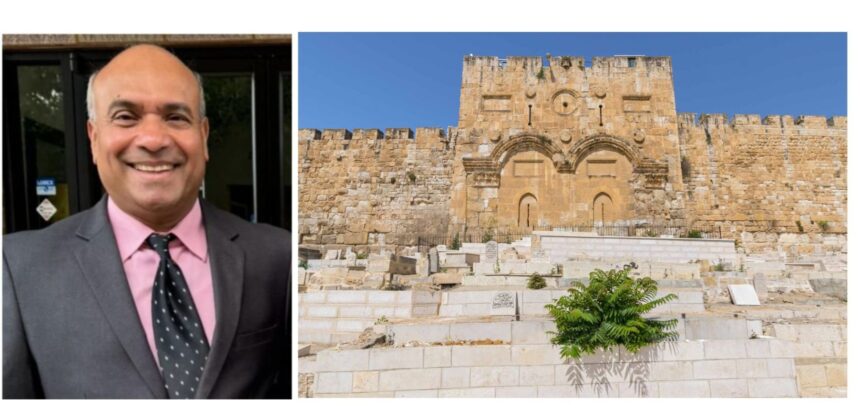
Stand for a moment on the Mount of Olives and look west across the valley. There, set into Jerusalem’s ancient eastern wall, is a gate that has been bricked shut for nearly five hundred years. No one passes through it. A cemetery lies before it. Yet this quiet, closed entrance carries one of the Bible’s most striking promises about the return of the Messiah.
The story begins with Jesus Himself. After His resurrection, He led His disciples to the Mount of Olives. There, as they watched, He was taken up into heaven. Two angels appeared and said, “This same Jesus, who has been taken from you into heaven, will come back in the same way you have seen him go into heaven” (Acts 1:11). The place of His departure would also be the place of His return.
Centuries earlier the prophet Zechariah had already pointed to that same mountain. He wrote, “On that day his feet will stand on the Mount of Olives, east of Jerusalem, and the Mount of Olives will be split in two from east to west, forming a great valley, with half of the mountain moving north and half moving south” (Zechariah 14:4). The return would not be quiet or hidden. The very ground would respond.
Then comes the detail about the gate. In a vision of the future temple, the prophet Ezekiel was shown the outer gate that faces east. Scripture records: “Then the man brought me back to the outer gate of the sanctuary, the one facing east, and it was shut. The Lord said to me, ‘This gate is to remain shut. It must not be opened; no one may enter through it. It is to remain shut because the Lord, the God of Israel, has entered through it. The prince himself is the only one who may sit inside the gateway to eat in the presence of the Lord’” (Ezekiel 44:1-3). The gate would stay closed until the rightful King—the Messiah—arrived.
History later added its own chapter. In the sixteenth century, Ottoman Sultan Suleiman the Magnificent ordered the eastern gate sealed with stone. Many believe he knew of the ancient prophecies and hoped to prevent their fulfillment. A cemetery was placed in front of the gate as a further barrier. For almost five hundred years the gate has remained shut, just as Ezekiel described.
Yet the earth itself seems to hold a quiet witness. Geological surveys in the twentieth century revealed a natural fault line running east to west beneath the Mount of Olives, aligned toward that sealed gate. The mountain already carries the fracture the prophet foresaw.
One day, according to these ancient words, the heavens will shake, feet will touch the Mount of Olives, the mountain will split, and the stones that once blocked the way will fall. The One who left from that mountain will return to it—and walk through the gate that was never meant to stay closed forever.
No human wall, no sealed stone, no carefully placed cemetery can stop what God has written. The closed East Gate of Jerusalem still stands as a visible reminder: the promise is still alive, the mountain is still waiting, and the King is still coming.