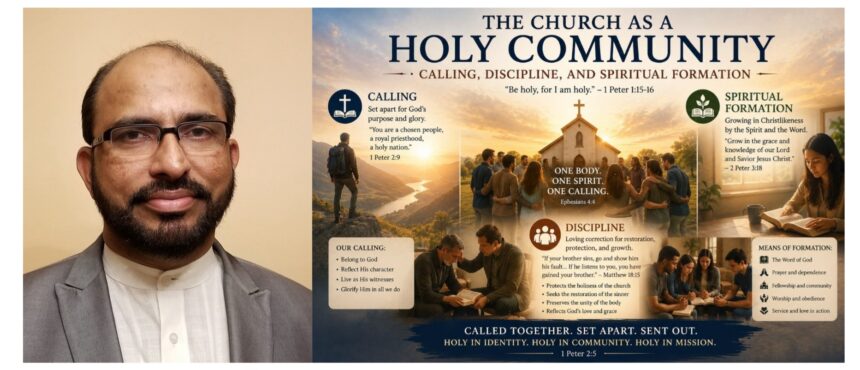
The Church as Holy Community: Vocation, Discipline, and Spiritual Formation
Rev. Dr. Mathew Philip
Abstract:
One of the most distinctive characteristics of the Church is holiness. God calls His people to be holy as He is holy. (see Leviticus 11:44-45; 19:2; 1 Peter 1:15-16) The Church is not simply a gathering of forgiven sinners but a community set apart for God’s purposes, transformed by His grace, and empowered by the Holy Spirit to reflect His character. This article explores the Church as a holy community, and discusses the divine call, the biblical function of church discipline, and the lifelong process of spiritual formation. These three dimensions demonstrate that holiness is at once a gift of God’s grace and a continuous seeking of faithful discipleship. In a culture often marked by moral compromise and spiritual complacency, the Church’s holiness is essential for its witness, unity, and mission.
Introduction:
The New Testament always describes the Church as a holy people. The word “church” (the people who have been called out by God) and the word “saints” (used often to refer to believers) literally mean “holy ones.” So holiness is not some optional ideal for only the most devout Christians; it is the calling of every believer, every congregation. God told Israel, “Be holy, for I am holy” (Leviticus 19:2), and the apostle Peter applies this same command to the Church (1 Peter 1:15–16). By Jesus Christ, believers have been redeemed, justified, and sanctified. But the Christian life is also a process of continual growth into closer conformity to Christ. The Church, as a community of holiness, reflects the character of God to the world. Its holiness is evidenced by its worship of God, its devotion to God, its love for others, its biblical discipline, and its continual spiritual renewal. Holiness is not withdrawal from the world but faithful witness within it.

The Divine Call to Holiness:
Holiness starts with God’s initiative. The Church is holy because God has selected and consecrated his people for himself. Paul calls believers “called to be saints” (Rom. 1:7) and emphasizes holiness as not a matter of human attainment but of God’s gracious calling. The Church belongs to the Lord. Through His death and resurrection, believers are redeemed from sin and set apart to God’s service. Peter calls Christians “a chosen generation, a royal priesthood, a holy nation, His own special people” (1 Peter 2:9). This identity is the source of all that the Church is and does. Holiness is simply the condition of being separated to God. This is both a position and a practice. Positionally, believers are declared holy by the atoning work of Christ. In practical terms, they are called to live as the people of that identity. This is not a call just to individual believers but to the whole community of faith. In union the Church shows forth the truth, love, justice, mercy, and righteousness of God, witnessing to His holiness. A holy Church makes God’s kingdom visible in a fractured world.
Holiness by Union with Christ:
The holiness of the Church is tied to its relationship with Jesus Christ. Paul says that Christ “loved the church and gave himself for it, that he might sanctify and cleanse it” (Ephesians 5:25–26). Christ is both the source and the pattern of holiness. He Who by His death cleanses the believer from sin; they receive the power to walk in newness of life by His resurrection life. Sanctification, therefore, is not only self-improvement but also participation in the life of Christ. The Holy Spirit works in the believer to produce the character of Christ and to enable the believer to grow in obedience. Jesus prayed that His followers might be sanctified through God’s truth (John 17:17). The Word of God, strengthened by the Holy Spirit, is the principal means of the Church’s continual renewal. The Church’s quest for holiness is ultimately Christ-focused. It does not seek moral perfection by means of legalism but spiritual change through abiding in Christ.
Church Discipline – Guarding the Holiness of the Community:
One area of the Church’s holiness that is often neglected is biblical discipline. Discipline is often mistaken in our culture for harsh criticism or rejection. But the Bible speaks of church discipline in terms of love, restoration, and covenant responsibility. Jesus gave principles of loving correction in Matt 18:15-17. Our goal is always reconciliation and restoration, never punishment. Paul likewise told the Corinthian church to deal with persistent sin for the sake of the spiritual health of the community (1 Corinthians 5). Church discipline serves a variety of important purposes. First of all, it preserves the holiness of the Church. Unrepentant sin can harm the spiritual life and witness of the whole congregation. Secondly, discipline seeks the restoration of the individual believer. Loving correction is a time for repentance and renewed fellowship. Thirdly, discipline preserves the credibility of the Church’s witness to the world. When a community tolerates open rebellion against the Word of God, it undermines its proclamation of the Gospel. Thus, healthy discipline is always exercised with humility and compassion and biblical wisdom. Galatians 6:1 urges believers to “restore such a one in a spirit of gentleness,” recognizing that all are in need of God’s grace.
Spiritual Formation – Growing in Christlikeness:
Holiness is not a one-time event but a lifelong process of spiritual formation. The Holy Spirit is constantly changing believers into the image of Christ. Paul writes that the purpose of God is for believers to be “conformed to the image of His Son” (Romans 8:29). Spiritual formation is the process of transformation of the whole person: mind, heart, character, and behavior. A number of practices facilitate this process: The Word of God: Scripture refreshes the mind and reveals the will of God. Spiritual growth is fed by regular reading, study, meditation, and faithful preaching. Prayer: Prayer enhances fellowship with God and fosters a dependence on His grace. In prayer believers confess sin, seek wisdom, and grow in intimacy with God. Worship: Corporate worship reminds believers of God’s greatness and resizes their hearts for His purposes. Worship deepens faith and renews spiritual sight. Fellowship: Spiritual growth happens in community. Through life together and mutual accountability, believers encourage, correct, and strengthen each other. Service: Serving others cultivates humility, compassion, and the love of Christ. Ministry is one of the primary ways that God shapes His people. These spiritual disciplines do not buy God’s favor but rather position believers to receive His transforming grace.
The Holy Spirit and the Holy Life:
There is no pursuit of holiness without the Holy Spirit. Human effort alone cannot produce genuine spiritual transformation. Paul also contrasts the works of the flesh with the fruit of the Spirit (Galatians 5:22-23). Love, joy, peace, patience, kindness, goodness, faithfulness, gentleness, and self-control are proof of the presence of the Spirit in believers. The Spirit convicts of sin, empowers obedience, illuminates Scripture, strengthens prayer, and equips believers for holy living. Therefore, the Church seeking holiness must be in constant dependence on the Holy Spirit. Humility, compassion, and love are the marks of Spirit-filled holiness, not pride or legalism. The fruit of the Spirit becomes visible within the life of the community as believers submit themselves to God’s transforming work.
Holiness and the Witness of the Church:
The holiness of the Church has a deep missionary significance. Jesus taught that the believers are the light of the world and the salt of the earth (Matthew 5:13-16). The Church bears witness to Christ in its message and its character. A holy community is the reality of God’s transforming power. Integrity, compassion, purity, forgiveness, generosity, and justice become visible means of expressing the gospel. But moral compromise weakens the witness of the Church. History shows that spiritual renewal has often begun with a renewal of the commitment to holiness among God’s people. The church’s uniqueness is not separation from society but faithful obedience within society. Christians act in the world, but they are formed by God’s truth rather than the values of the world.
Challenges to Holiness in Today’s World:
The modern church faces many challenges to its identity as a holy church. Secularism, moral relativism, consumerism, and individualism are always pressuring believers to fit in with the culture around them. There is also the peril of either minimizing holiness to external rule-keeping or privatizing it to spirituality apart from community life. Biblical holiness is a middle way. It combines inner transformation and outer obedience, personal devotion and communal responsibility. Hence, the Church must deliberately create environments where spiritual growth, accountability, biblical teaching, and Christlike love all grow together.
Summary:
The Church is called to be a holy community because it belongs to a holy God. Believers are set apart by the redemptive work of Christ and the transforming power of the Holy Spirit to be conformed to the character of God in the world. This holy calling manifests itself as faithful discipleship, loving discipline, spiritual formation, and ongoing dependence on God’s grace. Holiness is not the absence of sin but the life of Christ in his people. The Church, in its pursuit of holiness, is called to be a faithful witness to the kingdom of God, bearing witness to His love, truth and righteousness in an ever-broken world. The Church, being rooted in Christ, led by Scripture, and empowered by the Holy Spirit, is called to be “a holy nation” glorifying God and pointing the world to Jesus Christ.