Jesus Christ: The Builder and Cornerstone of the Church
Rev. Dr. Mathew Philip
Abstract:
The Christian Church is at the center of God’s redemptive work in history, but its existence and stability are completely contingent upon the person and work of Jesus Christ. The Scriptures represent Christ as the author of the Church but also as its builder, cornerstone, head, and sustaining power. This article considers the biblical and theological importance of Christ as the builder and cornerstone of the Church, noting that the identity, unity, mission, and future hope of the Church are founded in Him alone. In a time of institutional uncertainty and spiritual fragmentation, the recovery of a Christ-centered understanding of the Church is still essential for faithful Christian witness and ministry.
Introduction:
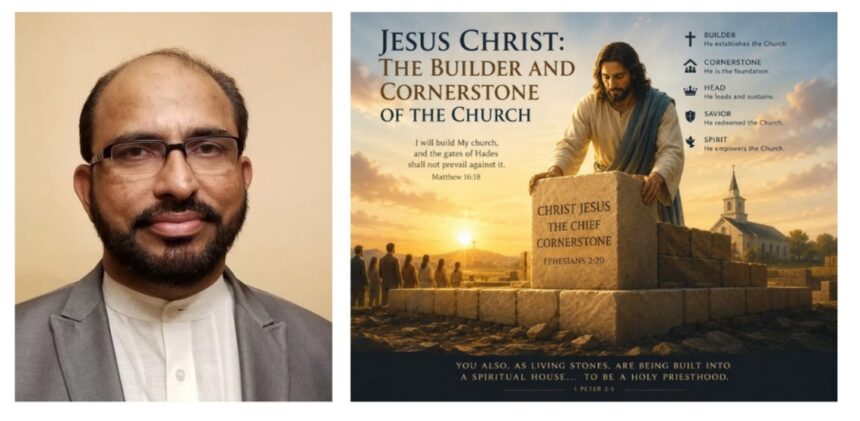
Throughout history, many institutions have risen and fallen. Empires and political systems and cultural movements have changed and declined. But the Church of Jesus Christ lives on through centuries, cultures, and continents. This endurance is not human strength, organizational brilliance, or institutional power. The Church lives because it is founded on Jesus Christ himself. Jesus promised Peter in Matthew 16:18, “I will build My church, and the gates of Hades shall not prevail against it.” Two fundamental truths emerge from this statement: first, that the Church belongs to Christ; and second, that Christ Himself is actively building it. The Church is not finally the product of apostles, pastors, denominations, or theologians. It is Christ’s Church, instituted by His authority, maintained by His presence, and directed to His eternal purpose. In the New Testament, Christ is also called the “chief cornerstone” (Ephesians 2:20), the stone on which the whole structure of the Church is built. These images of the builder and cornerstone together give a rich theological understanding of the nature, mission, and stability of the Church.
Christ the Builder of His Church:
The divine initiative at the heart of ecclesiology is expressed in the words of Jesus, “I will build My church.” The Church is not a human enterprise, the mere product of religious fervor or social need. Rather, it springs from the saving mission of God accomplished through Christ. The Church was birthed out of Jesus’ ministry on earth. He called disciples, preached the kingdom of God, revealed divine authority, and gathered a community around himself. Christ’s death, resurrection, ascension, and the pouring out of the Holy Spirit at Pentecost brought the Church into being in its fullest sense. Christ redeemed mankind from sin and reconciled believers to God through His sacrificial death on the cross. And in His resurrection, He brought in a new creation life. Through the Holy Spirit He has united believers into one spiritual body. Then all in the life of the Church depends on the redemptive work of Christ.
Christ is still building His Church:
It is important to note that Christ did not simply create the Church in the past and then walk away from it. He’s building it right now. The risen Christ is calling people from every nation, transforming lives by the gospel and preparing the church for mission. Every genuine conversion, every act of discipleship, and every faithful ministry is an expression of Christ’s continuing work as builder of the Church. This truth provides both humility and confidence.
The church is to be Christ-centered, not pastor-centered:
The main purpose of the church is to glorify Jesus Christ, not to exalt any human leader. Pastors are called servants and shepherds whose main task is to lead the members of the church to Christ, who is considered the real head of the Church as in Colossians 1:18. When churches focus on the individual pastor, the personalities can get in the way of the gospel message and create an unhealthy dependence on human authority. Indeed, a Christ-centered church is one that emphasizes worship, solid biblical teaching, discipleship, and strict adherence to Christ. Healthy pastors consistently reinforce that the church’s hope is not in any preacher or leader but in Jesus Christ alone. This preserves the integrity and focus of the church’s mission. So, church leaders are not owners or architects of the Church, but servants sharing in the work of Christ. Meanwhile believers can be hopeful, as the future of the Church depends not only on human capacity. Christ Himself is committed to the building of His Church.
Christ the Church’s Cornerstone:
Christ is not just the builder but also the cornerstone of the Church. The cornerstone was the most important stone in ancient construction. It fixed the position, stability, and orientation of the whole structure. If the cornerstone was loose or in the wrong spot, the building would fall down eventually. The apostle Paul writes, “built upon the foundation of the apostles and prophets, Christ Jesus Himself being the chief cornerstone” (Ephesians 2:20). Similarly, Peter talks about Christ as the “living stone” that men reject but God has chosen (1 Peter 2:4-6). This imagery is suggestive of several important truths. First, Christ is the basis of the Church’s identity. The Church is not fundamentally characterized by nationality, denomination, tradition, or culture. It is determined by its relation to Christ. Where Christ is truly confessed and followed, there is the true Church. Secondly, Christ is the source of the unity of the Church. Human societies often divide along lines of race, language, politics, and social class. But in Christ we are all united into one body regardless of our background. The cornerstone is what pulls the entire structure into a coherent whole. Third, it is Christ who governs the course and the nature of the Church. Just as a building aligns itself with its cornerstone, so must the Church align itself with the teaching, example, and mission of Christ. When churches focus on worldliness, political influence, or personal interests over Christ, they are no longer spiritually aligned. A Christ-centered Church must always return to the gospel and the authority of Scripture.
The Church Sustained by Christ:
The New Testament speaks of Christ not only as builder and cornerstone but also as Head of the Church. Colossians 1:18 says, “He is the head of the body, the church.” This means that Christ has authority, guidance, and life-giving power over His people. The Church cannot thrive apart from Christ. Programs and structures and traditions may have their value; but spiritual vitality is born only in communion with Him. This is the truth that Jesus Himself teaches in John 15:5: “Apart from Me, you can do nothing.” This dependence on Christ has practical implications for ministry. Worship should be Christ-centered, not personality-centered. Preachers must preach Christ, not just motivational thoughts. Mission must be rooted in the compassion and truth of Christ. Leaders should model Christ’s humility and servant-heartedness. When the Church is connected to Christ, it grows spiritually, is united, and is effective. When it turns away from Him, it is spiritually divided and weak.
Church and the Promise of Victory:
One of the most encouraging parts of Christ’s promise is that “the gates of Hades shall not prevail against it” (Matt. 16:18). The church has been persecuted, opposed, divided, and culturally hostile throughout history. And yet it has never been destroyed. This endurance shows the faithfulness of Christ. The survival of the Church is not a matter of human resilience but of divine preservation. Christ keeps and guards His own from generation to generation. This promise also anticipates the future consummation of the Church. Christ the builder and cornerstone shall finish His work. Scripture points to a day when the Church will be presented as the spotless bride of Christ, fully sharing in his glory and eternal kingdom (Ephesians 5:26-270).
Summary:
Jesus Christ stands at the center of the Church’s existence. He is the divine builder who established the Church by His redemptive work and the chief cornerstone on which the entire structure rests. All of the Church’s identity, unity, mission, strength, and hope is found in Him alone. In a world of instability and spiritual confusion the Church must constantly be brought back to its foundation in Christ. Programs may be altered, cultures may change, institutions may fail, but Christ is the unshakable foundation. As long as the Church remains rooted in Him, it will continue to fulfill God’s eternal purpose until the day Christ returns in glory.