Rev. George Varughese (Shaji Karackal)
En Gedi (also spelled Ein Gedi), Judaean Desert of Israel: # The Scroll That Fire Couldn’t Silence
For nearly half a century, it was only a blackened lump—too fragile to open, too precious to discard. Then science gave an ancient voice a second chance.
In 1970, archaeologists excavating an ancient synagogue at En-Gedi uncovered what looked like a small cylinder of charcoal. It was a scroll, burned in a fire, centuries earlier and crushed into brittle layers. Even touching it risked turning it to ash. So the artifact was preserved, unread and seemingly beyond recovery.
Then came an astonishing second look.
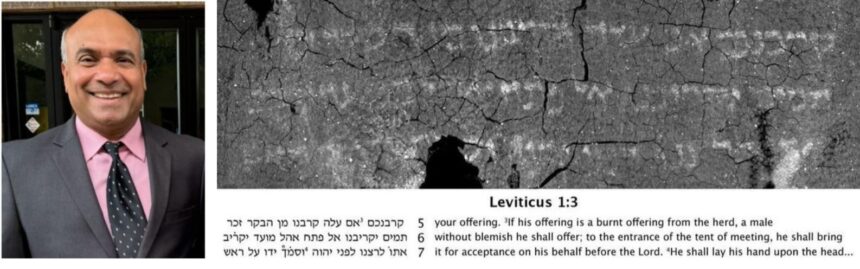
Using X-ray micro-CT scans and a technique called virtual unwrapping, researchers mapped the scroll’s hidden layers and digitally flattened them—without physically opening it. The text that emerged was from the beginning of Leviticus, written in Hebrew. Radiocarbon analysis places the parchment in the third or fourth century CE, though handwriting analysis has suggested it may be older.
The discovery carried another surprise: the readable words matched the consonantal text and paragraph divisions of the medieval Masoretic Hebrew Bible. A manuscript separated from those later copies by centuries had preserved a remarkably familiar text.
For Christian readers, Leviticus may feel distant at first—filled with ancient instructions about worship, sacrifice, and holiness. Yet its pages belong to the scriptural heritage Christianity shares with Judaism. And here, in the remains of a synagogue, the words had endured fire, time, and the limits of human eyes.
The scroll did not survive intact. Much of it remains lost. But enough remained to be read.
That is what makes En-Gedi more than a tale of clever technology. It is a story about patient preservation, careful scholarship, and the possibility that what appears ruined may still hold meaning. The researchers did not force the scroll open; they found a way to listen without destroying it.
A charred scroll cannot speak in its own voice. But, layer by fragile layer, this one spoke again. Even after the flames, a witness remained.