

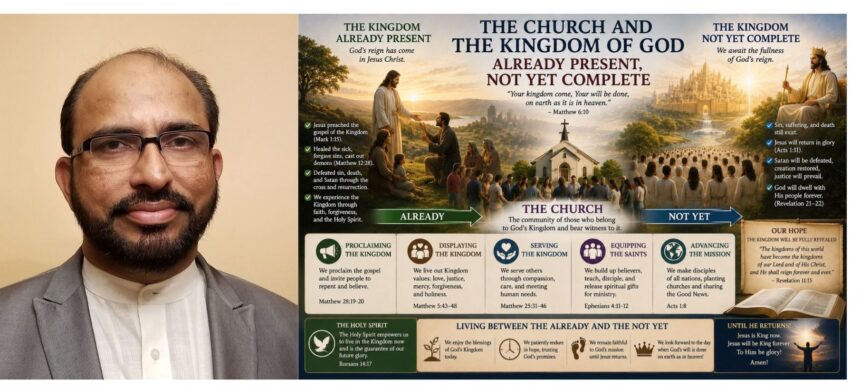
The Church and the Kingdom of God: Present, but Not Complete
Rev. Dr. Mathew Philip
Abstract:
The relationship between the Church and the Kingdom of God stands at the heart of New Testament theology. These two concepts are closely related, but they are not the same thing. The Kingdom of God is God’s sovereign reign established through the life, death, resurrection, and ascension of Jesus Christ. The Church is the redeemed community that lives under that reign and bears witness to it. In the New Testament the Kingdom is a present reality and a future hope, inaugurated but not yet consummated. This article explores the biblical relationship between the Church and the Kingdom of God, emphasizing the “already–not yet” nature of the Kingdom, the Church’s mission as the community of the Kingdom, and the hope of Christ’s future reign in the new creation.
Introduction:
The central theme of Jesus’ preaching was the Kingdom of God. His first public proclamation was, “The time is fulfilled, and the kingdom of God is at hand. Repent, and believe in the gospel” (Mark 1:15). In His ministry, Jesus taught about the Kingdom in parables, miracles, and acts of compassion. He revealed that God’s reign had come into human history in a new and decisive way. At the same time, Jesus taught His disciples to pray, “Your kingdom come” (Matthew 6:10), which means that the Kingdom has not yet been fully realized. This tension is the heart of the theology of the New Testament. Through Christ God’s Kingdom has begun, but it will not be fully realized until He returns. Here the Church lives in this tension. It is the community of those who have entered the Kingdom of God through faith in Christ, yet it continues to anticipate the fullness of God’s reign when Christ returns in glory. Understanding this relationship informs the Church’s worship, mission, ethics, and hope.
The Meaning of the Kingdom of God:

The Kingdom of God is not a place or a territory, but it is primarily a reference to the sovereign rule and reign of God. God is portrayed in the Old Testament as the king over all creation. “The Lord has established His throne in heaven, and His kingdom rules over all” (Psalm 103:19), says the psalmist. God has always ruled the universe, but His saving rule came into history in a unique way through Jesus Christ. Christ came as the promised King, fulfilling Old Testament expectations of the Messiah. Jesus demonstrated the Kingdom in His teaching, miracles, healing ministry, forgiveness of sin, and victory over Satan. Each healing and deliverance was proof that the kingdom of God was invading a fallen world. So the Kingdom is not merely heaven after death, but God’s active rule changing lives and restoring creation to His purposes.
The Kingdom Already Present:
One of the most amazing things Jesus taught was that the Kingdom had already come in his ministry. When they accused Jesus of casting out demons by the power of Satan, he responded, “If I by the Spirit of God cast out devils, no doubt the kingdom of God is come unto you” (Matt. 12:28). His miracles were signs that the kingdom of God had intruded into the kingdom of darkness. The blind received their sight, the lame walked, lepers were cleansed, the dead were raised, and the poor had good news preached to them. The cross and the resurrection were the deciding victories of the Kingdom. Christ was killed to destroy sin. His resurrection was His victory over death. Through His ascension, He was enthroned as Lord and King. But the believers today already get a foretaste of many blessings of the Kingdom, such as the forgiveness of sins, reconciliation with God, the indwelling Holy Spirit, victory over the power of sin, fellowship with God’s people, and participation in God’s mission. Paul says that God “has delivered us out of the power of darkness and has translated us into the kingdom of the Son of his love” (Colossians 1:13). Believers are already in Christ’s Kingdom.
The Kingdom Not Yet In Fullness:
Although the Kingdom has been inaugurated, it has not yet reached its final fulfillment. Sin still exists. Death continues. Creation is groaning under the effects of the fall. There are still war, injustice, suffering, and persecution. This tension is not unusual in Jesus’ parables. The wheat and the tares grow together until the harvest (Matt. 13:24–30). The mustard seed is small, but it grows large. The Kingdom grows in silence until its final disclosure. The New Testament always looks believers forward to the coming of Christ, when the Kingdom will be revealed in its fullness. At His second coming, Satan will be finally defeated, death will be abolished, creation will be renewed, justice will prevail, and God’s people shall dwell with him forever. Revelation 11:15 reads, “And He shall reign forever and ever! The kingdoms of this world have become the kingdoms of our Lord and of His Christ.” Thus, the Church lives in hope, in the knowledge that the present age is only provisional and that the fullness of the Kingdom of God is yet to come.
The Church as the Community of the Kingdom:
The Church is not the same as the Kingdom of God but is inseparably connected to it. The Kingdom is the universal reign of God; the Church is the fellowship of those who, in faith in Christ, submit to that reign. The Church serves as the custodian, instrument, and witness of the Kingdom, but it is not the Kingdom itself. The Church serves the Kingdom in several ways. The Church proclaims the Kingdom in its preaching and evangelism; it displays the Kingdom in demonstrating Kingdom values of worship, holiness, justice, compassion, forgiveness, generosity, and reconciliation; and it serves the Kingdom in participating in God’s mission of making disciples, planting churches, serving the community, and witnessing to Christ throughout the world. Its mission points beyond itself to the reign of God.
Kingdom Ethics – Living Between the Times:
Believers are part of the Kingdom, so they are called to live by Kingdom values even while living in a fallen world. The ethics of God’s Kingdom are set forth in the Sermon on the Mount (Matt 5-7). The citizens of the Kingdom practice humility, mercy, purity, peacemaking, forgiveness, and love for enemies. These values are often contrary to worldly systems of power, greed, and self-interest. The church becomes a prophetic community as it embodies God’s future in the present. It shows what life looks like under God’s reign. Christian ethics remind believers that Christian discipleship touches all areas of life – family, work, relationships, justice, stewardship, and public witness.
The Holy Spirit and Kingdom:
The Holy Spirit is present evidence that God’s Kingdom has begun. Jesus promised that His followers would get power when the Holy Spirit came upon them (Acts 1:8). Pentecost was the birth of the Spirit-empowered witness of the church. The Spirit enables believers to experience Kingdom life now through new birth, spiritual gifts, sanctification, fellowship, worship, and mission. Paul describes the Kingdom as “righteousness and peace and joy in the Holy Spirit” (Romans 14:17). The Spirit is thus the present experience and the guarantee of God’s future Kingdom.
The Hope of the Coming Kingdom:
Christian hope is eschatological in the last resort. The Church sees beyond its present difficulties to the glorious return of Christ. The New Testament repeatedly urges believers to persevere because one day the Kingdom will be fully revealed. Revelation ends with the vision of a new heaven and a new earth where God dwells with His people, every tear is wiped away, death is abolished, and righteousness reigns forever (Revelation 21–22). This future hope is not escapism but motivation for faithful service for the Church. The return of Christ motivates believers to work hard, serve faithfully, live holy, and share the gospel boldly.
Difficulties Comprehending the Kingdom:
Christians have at times confused the Church with the Kingdom. Some have equated the Kingdom with the institutional Church itself. Others have reduced it to a mere future heaven. Some have emphasized social change but have forgotten personal conversion; others have emphasized personal salvation but have forgotten justice and compassion. The biblical view maintains balance. The Kingdom is spiritual, yet visible; present, yet future; personal, yet universal; already inaugurated, yet awaiting consummation. The Church faithfully lives within this biblical tension.
Summary:
The church and the kingdom of God are inextricably connected, yet carefully distinguished. The Kingdom is God’s sovereign reign, begun in Jesus Christ. The Church is the redeemed community that lives under that reign and bears witness to it. For those who believe in the blessings of forgiveness, the Holy Spirit, and new life in Christ, the Kingdom of God is already a reality. Yet they look for the glorious day when Christ returns to set up His Kingdom in its fullness. The Church lives in the “already” and the “not yet.” It preaches the gospel, lives out Kingdom values, serves the world compassionately, and lives in anticipation of the coming reign of Christ. This hope shapes all the identities and mission of the Church. Until the King returns, the Church lives faithfully as an outpost of His Kingdom, worshipping the risen Lord, proclaiming His gospel, making disciples, and longing for the day when “the kingdom of the world has become the kingdom of our Lord and of His Christ” (Revelation 11:15). Then the kingdom of God will be complete, the glory of God fully displayed, and his people will live with him forever.


